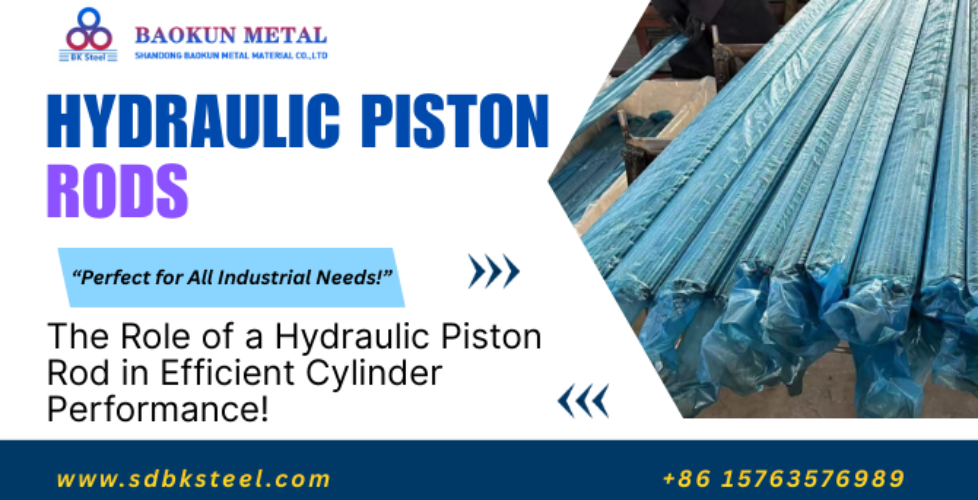
The Role of a Hydraulic Piston Rod in Efficient Cylinder Performance!
In the highly dynamic world of hydraulic systems, precision, power, and reliability are non-negotiable. Whether it’s in construction equipment, agricultural machinery, industrial automation, or material handling applications, hydraulic cylinders play a pivotal role in providing the linear motion and force required for complex operations. At the core of this system lies a key component that silently carries a major share of the workload — the Hydraulic Piston Rod.
Often underestimated, the Hydraulic Piston Rod is a high-load-bearing component designed to transmit force and motion within the hydraulic cylinder. In fact, its surface quality, material properties, and structural strength directly impact how well a cylinder performs under continuous and demanding conditions. Simply put, a well-designed and properly manufactured Hydraulic Piston Rod is essential for maintaining system efficiency, reducing downtime, and extending equipment lifespan.
At Shandong Baokun Metal Material Co. Ltd, we take pride in providing high-quality Hydraulic Piston Rods that meet the performance needs of some of the toughest industrial environments. Through precision manufacturing, advanced chrome plating, and rigorous quality control, our piston rods consistently deliver superior surface finishes, high strength, and excellent fatigue resistance.
What is a Hydraulic Piston Rod?
A Hydraulic Piston Rod is a metallic shaft, usually made from high-strength steel, that connects the hydraulic cylinder’s piston to the machine component being moved. It transmits the generated hydraulic force from the piston to the external mechanism — be it a boom, blade, arm, or actuator.
Typically, the piston rod extends and retracts through the cylinder, with its external portion exposed to different environmental and mechanical stresses. Therefore, both surface quality and structural durability are essential in ensuring reliable operation.
Key Characteristics of a Hydraulic Piston Rod:
- High Strength and Load-Bearing Capacity
- Corrosion and Wear Resistance (often chrome-plated)
- Smooth Surface Finish for Seal Compatibility
- Fatigue Resistance Under Repeated Stresses
- Precision in Straightness and Diameter Tolerances
How the Hydraulic Piston Rod Influences Cylinder Performance?
The role of a piston rod is more than just mechanical motion. It contributes significantly to overall hydraulic efficiency and safety in the following ways:
1. Transmits Linear Force Accurately
The primary task of a Hydraulic Piston Rod is to convert hydraulic energy into usable mechanical force. Any deflection, bending, or warping in the rod can reduce the force transmission efficiency and increase wear on the cylinder seals and bushings.
2. Maintains Seal Integrity
A smooth and precisely machined rod surface ensures effective contact with seals and wipers. This minimizes fluid leakage and contamination, both of which can severely impact system performance.
3. Withstands Extreme Loads and Cycles
High-quality piston rods are engineered to endure high dynamic loads and thousands of operating cycles without fatigue. Overloaded or poorly manufactured rods can crack, bend, or break over time, resulting in costly downtime.
4. Reduces Friction and Wear
A piston rod with optimal surface hardness and low surface roughness reduces friction between moving components. This increases energy efficiency and prolongs the lifespan of the cylinder and seals.
5. Enhances Corrosion Resistance
Because the rod moves in and out of the cylinder, it’s continuously exposed to air, moisture, dirt, and corrosive elements. Chrome plating or other surface treatments provide a protective barrier that prevents rust and pitting.
Key Manufacturing Features of High-Performance Hydraulic Piston Rods:
At Shandong Baokun Metal Material Co., Ltd., we manufacture Hydraulic Piston Rods with the following features:
- Raw Material Selection
Most rods are made from medium carbon steel grades such as SAE 1045, CK45, or alloy steel like 42CrMo4. These materials strike the perfect balance of strength, toughness, and machinability.
- Precision Straightening
Rod straightness is critical for avoiding piston misalignment. Our rods undergo high-precision straightening processes to limits tighter than 0.15mm/m.
- Surface Hardness and Finish
Rods are induction hardened or chrome plated to improve wear resistance. Typical surface hardness achieved is HRC 50–55, with surface roughness as low as Ra ≤ 0.2μm.
- Chrome Plating Technology
Chrome is applied electrochemically to provide a hard, smooth, and corrosion-resistant finish. Our advanced processes ensure uniform thickness and high adhesion.
- Quality Inspection
Every piston rod is subjected to:
- Ultrasonic testing
- Hardness testing
- Surface roughness measurement
- Dimensional tolerance checks
- Corrosion resistance evaluation
How to Choose the Right Hydraulic Piston Rod?
Selecting the right Hydraulic Piston Rod involves various technical considerations:
- Diameter and Length – Based on cylinder stroke length and power requirements
- Material – Choose carbon steel or alloy steel according to system pressure
- Surface Finish & Coating – Chrome plated or nitride-coated depending on environment
- Hardness Level (HRC) – Higher hardness = better wear resistance
- Corrosion Resistance – Consider stainless-steel rods in marine or humid environments
- Precision Grade – For critical sealing applications, tighter tolerances are essential
Applications of Hydraulic Piston Rods in Industry
Hydraulic Piston Rods are used across a wide range of applications, including:
- Construction Equipment
Excavators, bulldozers, backhoes utilize piston rods in lifting and arm control cylinders. - Agricultural Machinery
Implements like plows, sprayers, and tractors depend on reliable hydraulic motion for field operations. - Industrial Machinery
Injection molding machines, press brakes, and conveyors use piston rods for force application and control. - Transport Vehicles
Tippers, dump trucks, and load carriers use hydraulic cylinders for tilting and lifting. - Material Handling
Forklifts, hydraulic lifts, and cranes use piston rods for positioning and elevation mechanisms.
Why Choose Hydraulic Piston Rods from Shandong Baokun?
At Shandong Baokun Metal Material Co., Ltd., we provide:
- SAE 1045 and CK45 Chrome-Plated Rods in various sizes
- Induction-hardening and nitriding services for added durability
- Custom machining and cut-to-length options
- ISO 9001:2015 certified production and robust quality control
- Bulk inventory and rapid delivery across Asia, Europe, and the Americas
We are proud to be a trusted partner for OEMs, hydraulic cylinder manufacturers, and system integrators worldwide.
Invest in Performance with the Right Hydraulic Piston Rod
The Hydraulic Piston Rod is more than just a moving rod—it is a vital link between hydraulic power and machine motion. From transferring force to sealing fluid and resisting corrosion, its role in maintaining system performance cannot be overstated.
Frequently Asked Questions (FAQ)
Q1: What material is best for hydraulic piston rods?
A: Medium carbon steel like SAE 1045 or CK45 is widely used due to its balance of machinability and strength. For high-load or challenging environments, 42CrMo4 or stainless steel may be preferred.
Q2: Why is chrome plating important for piston rods?
A: Chrome plating increases the surface hardness and provides excellent wear and corrosion resistance. It also offers a smooth finish to reduce friction with seals.
Q3: What surface finish is recommended for seals to work effectively?
A: The ideal surface roughness is Ra ≤ 0.2–0.4μm to ensure long-lasting seal life and efficient hydraulic movement.
Q4: Can I use the same rod for marine and industrial applications?
A: While the same base rod can be used for both, marine applications require additional corrosion protection, such as stainless steel or specialized coatings.
Q5: How long does a hydraulic piston rod typically last?
A: With proper design, surface treatment, and maintenance, a Hydraulic Piston Rod can last millions of cycles under normal operating conditions.