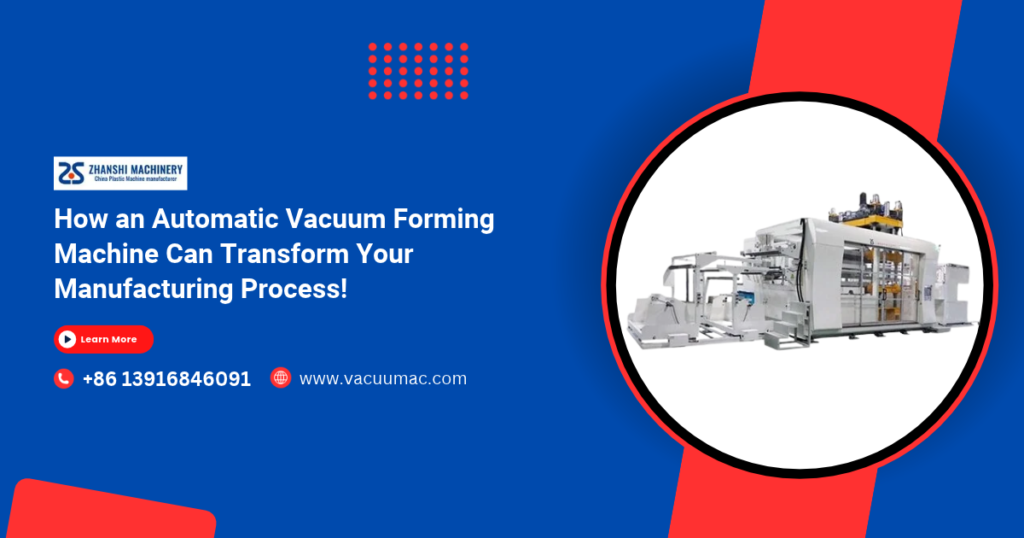
How an Automatic Vacuum Forming Machine Can Transform Your Manufacturing Process! [News]
Shanghai, China, 19.11.206 – In today’s fast-paced and competitive manufacturing landscape, operational efficiency and product quality have become non-negotiable standards for success. As market demands evolve, businesses in industries such as packaging, automotive, electronics, medical devices, and consumer goods are seeking ways to enhance production output, ensure precision, and minimize waste. This is where the evolution of the automatic vacuum forming machine has emerged as a powerful game-changer.
Unlike traditional manual or semi-automatic methods, an automatic vacuum forming machine leverages advanced automation, precise controls, and integrated technologies to revolutionize the way thermoplastic products are made. For manufacturers, the shift to automation does not simply mean faster cycle times. It represents a comprehensive transformation that touches every aspect of the production process—from initial material loading and heating, to forming, trimming, stacking, and quality assurance. These advancements lead to increased throughput, reduced labor costs, consistent quality, and enhanced scalability.
Understanding Automatic Vacuum Forming
To appreciate the transformative potential of an automatic vacuum forming machine, it is essential to understand how the process works and why automation makes a significant difference.
What is Vacuum Forming?
Vacuum forming is a type of thermoforming—a process that involves heating a plastic sheet until it becomes pliable and then forming it over a mold using suction (vacuum). Once the material cools, it takes the shape of the mold and can be trimmed to create the final product. Vacuum forming is commonly used to manufacture packaging trays, blisters, clamshells, automotive parts, device enclosures, and numerous other products.
Manual versus Automatic Vacuum Forming
Traditionally, vacuum forming processes were handled manually or semi-automatically, which required significant operator involvement. While these machines can be effective for prototyping or small-batch production, they limit efficiency and scalability due to:
- Increased labor costs
- Higher chances of human error
- Slower, less consistent cycle times
- Limited ability to handle complex or multi-stage operations
In contrast, an automatic vacuum forming machine automates critical steps such as sheet feeding, heating, forming, cooling, trimming, and even stacking or packaging. The result? Significantly increased production speed, superior consistency, and improved resource allocation.
Key Ways an Automatic Vacuum Forming Machine Transforms Manufacturing
Let’s delve into several specific areas where an automatic vacuum forming machine can become an engine of transformation in your business.
1. Increased Production Efficiency
Perhaps the most obvious advantage is dramatic improvement in throughput. By automating sheet loading, heating, forming, and downstream handling, you can achieve:
- Faster cycle times
- Reduced downtime
- Unattended shifts (lights-out manufacturing)
- Ability to schedule production 24/7
For instance, modern automatic vacuum forming machines from Shanghai Zhanshi Mechanical Equipment Co., Ltd. can often double or triple the output compared to manual systems, drastically reducing the cost per part.
Also Read: How an Automatic Vacuum Forming Machine Transforms Your Production Line!
2. Consistent Quality and Reduced Defects
Quality consistency is crucial in today’s competitive market. Automation minimizes the chance for human error and enables:
- Precise temperature control
- Uniform material distribution and forming
- Automated detection of process deviations
- Repeatable cycles, batch after batch
This ensures that each product meets strict dimensional and aesthetic standards, enhancing your brand’s reputation for reliability.
3. Labor Savings and Improved Workforce Utilization
By replacing repetitive, labor-intensive tasks with automation, your team can focus on more strategic work—such as process optimization, quality assurance, or machine supervision. This not only reduces costs but also helps address workforce shortages and improves employee satisfaction.
4. Real-Time Process Monitoring and Control
The best automatic vacuum forming machines are engineered with digital control systems that record, monitor, and analyze every aspect of the process. Features such as:
- Programmable recipes for different product types
- Touchscreen human-machine interfaces (HMI)
- Fault detection and alarm systems
- Data collection for quality and performance analysis
allow manufacturing managers to make data-driven improvements and instantly address issues before they impact product quality or yield.
5. Flexibility and Rapid Changeovers
Markets change fast, and new product launches are more frequent. With automatic changeover features—including drop-in molds, programmable settings, and modular downstream equipment—you can:
- Switch between products with minimal downtime
- Respond quickly to changes in demand
- Test and implement new designs rapidly
This agility boosts competitiveness and helps your business take full advantage of new opportunities.
6. Lower Energy Consumption and Material Waste
Automation brings greater precision to heating cycles, vacuum application, and trimming operations. By optimizing only the necessary process parameters:
- Energy use is reduced, cutting utility costs
- Material waste is minimized, which is both environmentally and financially beneficial
Some state-of-the-art machines even feature energy recovery systems and integrate scrap recycling for closed-loop production.
7. Enhanced Safety and Compliance
Automated machines come with built-in safety features such as:
- Safety curtains, light guards, and physical enclosures
- Emergency stop functions
- Automated shutdown in the event of faults
These features significantly reduce the risk of operator injury, making it easier to comply with workplace safety regulations.
8. Integration with Industry 4.0 and Smart Manufacturing
An automatic vacuum forming machine from a leading supplier like Shanghai Zhanshi Mechanical Equipment Co., Ltd. is ready for the factory of the future:
- IoT connectivity for remote monitoring and service
- Integration into MES (Manufacturing Execution Systems)
- Predictive maintenance alerts using real-time data
Such connectivity drives intelligent manufacturing and maximizes your investment.
9. Broader Material and Product Capabilities
Because of advanced controls, these machines can process a broader spectrum of thermoplastic materials, including:
- Traditional plastics: PET, PVC, HIPS, PP, ABS, etc.
- Recycled and bio-based polymers
- High-performance engineering plastics
You gain the ability to offer new, innovative products while meeting sustainability goals.
10. Long-Term Cost Savings and Business Growth
While the initial investment for an automatic vacuum forming machine may be higher than a manual or semi-automatic system, consider the return on investment (ROI):
- Lower operational costs over time
- Higher production volumes
- Capability to win bigger, more complex contracts
- Improved competitive positioning
The cumulative savings and new revenue opportunities quickly justify the outlay.
Automatic Vacuum Forming Machine Applications
Let’s look at how industries benefit from these advancements:
- Packaging: High-speed production of food trays, blister packs, and disposable containers, with integrated stacking and counting.
- Automotive: Large, durable interior and exterior vehicle components made with tight tolerances.
- Medical: Sterile, dust-free packaging and device trays produced with reliable, audit-ready documentation.
- Consumer Goods: Attractive, consistent, custom packaging, and product housings delivered to tight deadlines.
- Electronics: Anti-static component trays with precise features for sensitive technology.
About Company:
Shanghai Zhanshi Mechanical Equipment Co., Ltd. specializes in advanced thermoforming equipment, offering reliable automatic vacuum forming machines and customized plastic manufacturing solutions worldwide.
Media Contact:
Company Name: Shanghai Zhanshi Mechanical Equipment Co., Ltd.
Contact Name: Lewis
Contact Phone: +86 13916846091
Address: No.26 Kangyuan Road, Zhujiajiao Industrial Zone, Qingpu District, Shanghai, China
Email: Daisy@smktek.com
Website: https://www.vacuumac.com/