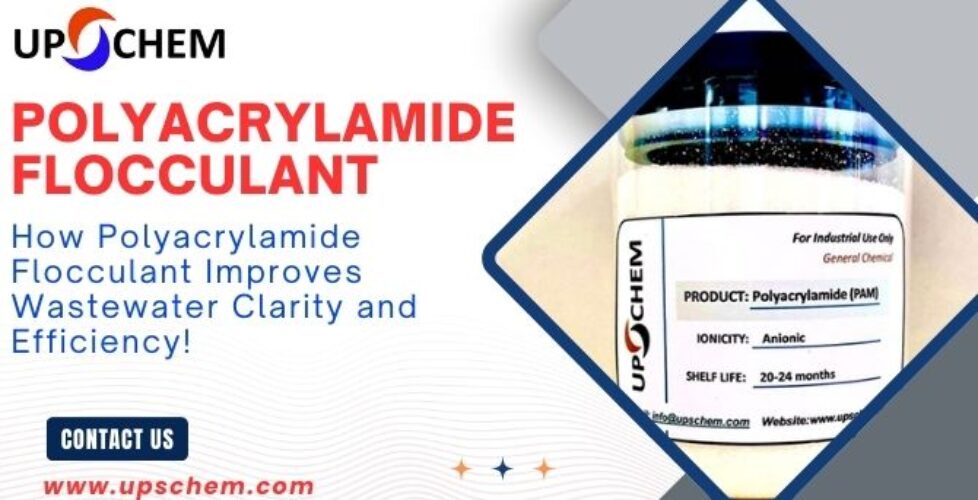
How Polyacrylamide Flocculant Improves Wastewater Clarity and Efficiency!
As industrial activities rapidly expand and environmental regulations become increasingly stringent, the need for effective and sustainable wastewater treatment solutions has never been more critical. Whether it’s a municipal treatment plant, a manufacturing facility, or a mining operation, maintaining high water clarity while ensuring treatment efficiency is vital for not only environmental compliance but also operational success.
This is where Polyacrylamide Flocculant plays a leading role.
At Shandong UPS Chemical Co., Ltd., we specialize in delivering high-performance, cost-effective chemical solutions, including a wide range of polyacrylamide-based flocculants tailored to various industries. While many companies focus solely on biological or mechanical treatment methods, advanced flocculation using polyacrylamide flocculants can drastically improve settling rates, sludge dewatering, and water clarity, leading to significant cost savings and process optimization.
What Is a Polyacrylamide Flocculant?
Polyacrylamide (PAM) is a synthetic, water-soluble polymer made from acrylamide subunits. As a flocculant, it is primarily used to aggregate suspended solids and colloidal particles in water into larger units, known as flocs, which can then be more easily separated through sedimentation, floatation, or filtration.
There are different types of polyacrylamide flocculants, including:
- Cationic PAM – Suitable for sewage sludge and industrial wastewaters with high organic content
- Anionic PAM – Ideal for raw water treatment, mining, and oily wastewater
- Non-ionic PAM – Used in cases with high levels of organic and inorganic matter without strong ionic characteristics
- Amphoteric PAM – Contains both anionic and cationic functional groups for complex systems
These variants are available in powder, emulsion, and granule forms and can be customized based on molecular weight, charge density, and solubility, making them extremely versatile for multiple treatment scenarios.
How Polyacrylamide Flocculant Works in Wastewater Treatment?
Understanding the mechanism at play offers insight into why polyacrylamide flocculants are so effective in clarifying wastewater:
- Bridging and Aggregation
PAM molecules act as bridges between suspended particles. Since these particles often carry surface charges that repel each other, PAM reduces that repulsion by neutralizing the charges and binding several particles together. - Charge Neutralization
Specific versions of PAM (e.g., cationic) neutralize the electrostatic charges on particles, facilitating aggregation. - Floc Formation
The larger aggregated particles (flocs) settle more quickly due to their increased mass and density, a crucial factor in clarifying water effectively and accelerating other treatment stages. - Dewatering Enhancement
After solid-liquid separation, the remaining sludge often undergoes mechanical dewatering. Polyacrylamide facilitates faster and more efficient separation, reducing disposal costs.
Key Benefits of Polyacrylamide Flocculant in Wastewater Treatment
1. Exceptional Water Clarity
Compared to traditional inorganic coagulants (e.g., alum, ferric sulfate), polyacrylamide produces cleaner effluent water by forming tighter, faster-settling flocs. As a result:
- Turbidity levels are drastically reduced
- Water can be more easily reused or discharged safely
- Filtration systems operate more effectively downstream
2. Faster Sedimentation and Greater Throughput
By bonding particles rapidly and forming large, heavy flocs, polyacrylamide flocculants speed up clarification, allowing treatment facilities to process higher volumes in less time. This directly improves plant capacity without requiring major capital upgrades.
3. Lower Sludge Volume
PAM flocculants produce:
- Less residual sludge than traditional aluminum or iron-based coagulants
- Drier sludge cake during dewatering, making transport and disposal easier and less expensive
For many industrial plants, sludge disposal is among the highest recurring costs in water treatment. PAM minimizes this cost.
4. Cost-Effective and Efficient Chemical Usage
Thanks to its high activity and targeted action, polyacrylamide is effective at low dosing concentrations, often in the range of 2–10 mg/L versus 50–100 mg/L for other chemicals. This:
- Reduces overall chemical consumption
- Lowers environmental impact
- Reduces scaling and maintenance problems in pipes and tanks
5. Versatility Across Water Qualities
Whether the wastewater is from food processing, mining, dyeing, oil refining, or municipal sewage, polyacrylamide flocculants can be tailored to treat wide-ranging pH levels, solid content, and chemical compositions.
At Shandong UPS Chemical Co., Ltd., we offer application-specific PAM formulations to address diverse process needs.
Application Best Practices for Maximum Efficiency
To achieve optimal results with polyacrylamide flocculants, consider the following best practices during implementation:
1. Select the Right Type of PAM
Identify the correct molecular weight and ionic charge best suited to your process. Our technical team provides lab-scale jar testing to determine this.
2. Dilute Properly
Powdered PAM should be diluted to about 0.1–0.5% concentration in water before dosing. Improper dilution may reduce flocculant effectiveness significantly.
3. Use Proper Dosing Equipment
Utilize precision polymer make-down units or dosing pumps to ensure consistent and uniform addition.
4. Monitor pH and Turbidity
PAM performs best within a specific pH window, and real-time turbidity control helps fine-tune dosing.
5. Train Operators
Even the best flocculant can underperform if not applied correctly. Proper operator training and SOPs minimize errors and maximize process efficiency.
Why Choose Shandong UPS Chemical Co., Ltd. for Your Polyacrylamide Flocculant Needs?
As a leading supplier of water treatment chemicals in China and international markets, Shandong UPS Chemical Co., Ltd. delivers:
- High-purity polyacrylamide flocculants, compliant with global standards
- Tailored solutions for varied industry applications
- Technical support, lab testing, and product optimization advice
- Stable supply chains and fast international delivery
- Environmentally friendly formulations available on request
From small-scale pilot plants to large industrial treatment facilities, we support your entire wastewater process with world-class polymers and performance-enhancing additives.
Clarity, Efficiency, and Sustainability – Unified by Polyacrylamide Flocculant
Maintaining high quality in wastewater treatment isn’t just about removing impurities—it’s about doing it efficiently, affordably, and in an environmentally friendly way. Polyacrylamide Flocculants are a key driver of such excellence, enabling faster sedimentation, better sludge dewatering, and higher-quality effluent.
Frequently Asked Questions (FAQ)
Q1: Is polyacrylamide safe for the environment?
A: Yes. While the base monomer acrylamide is toxic, fully polymerized polyacrylamide is non-toxic and stable. We also offer biodegradable and eco-friendly versions of our products.
Q2: Can polyacrylamide be used with other coagulants?
A: Absolutely. It is often used in tandem with coagulants like alum or ferric chloride, which destabilize particles, while the PAM handles efficient aggregation.
Q3: How long can a prepared polyacrylamide solution be stored?
A: Prepared solutions (0.1–0.3%) are best used within 24–48 hours for optimal activity. Emulsion forms tend to have greater stability over time.
Q4: What makes polyacrylamide better than traditional flocculants?
A: PAM requires lower dosages, creates less sludge, and forms stronger flocs, resulting in improved efficiency and reduced operating costs.
Q5: Can your flocculants be used in potable (drinking) water systems?
A: Yes, we offer drinking-water grade PAM flocculants manufactured under strict production standards.