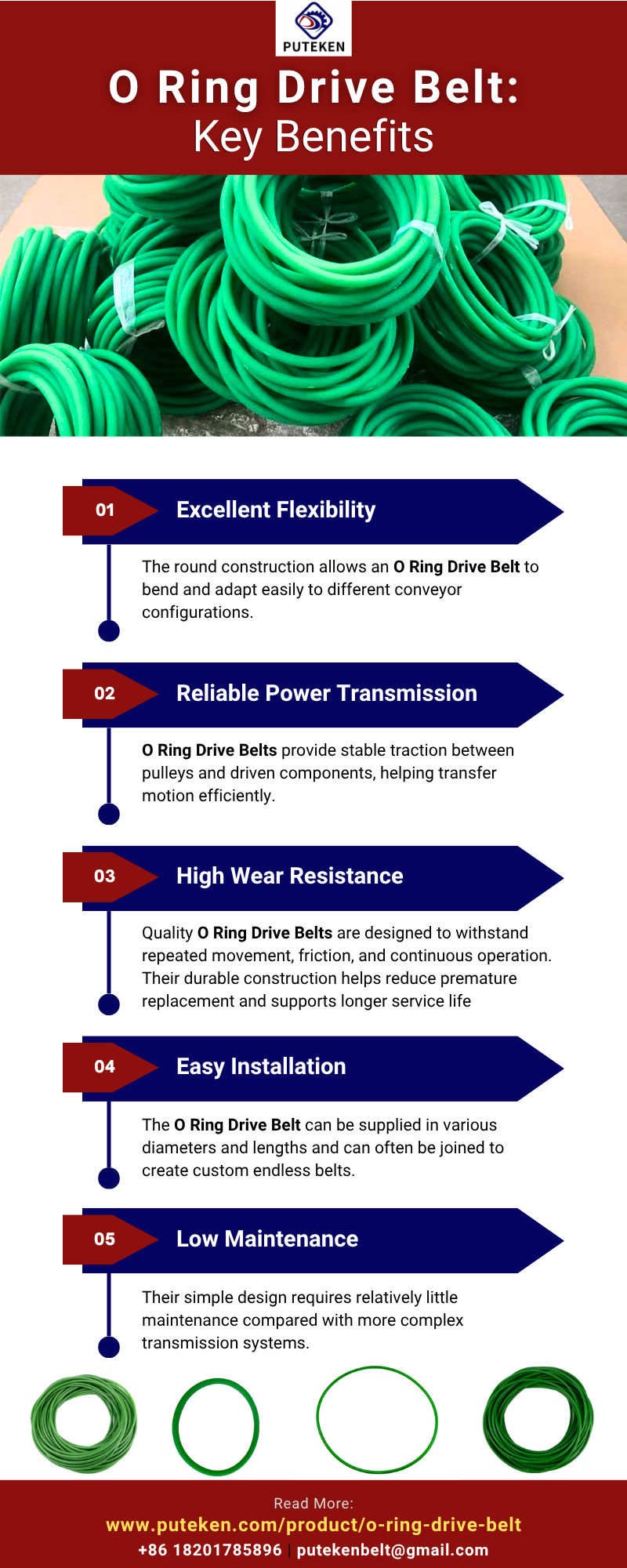
Modern conveyor systems require reliable, flexible, and low-maintenance components to maintain smooth material handling and consistent production. An O Ring Drive Belt is an excellent choice for conveying applications where efficient power transmission, flexibility, and dependable performance are essential. Designed for smooth operation, O ring belts can provide stable movement while reducing vibration and noise during continuous conveying.
One of the key advantages of an O Ring Drive Belt is its flexibility. It can be used with various conveyor configurations and is suitable for applications requiring curves, transfers, and compact layouts. Its durable construction offers good resistance to wear, abrasion, and repeated bending, helping extend service life and reduce replacement frequency. The belt is also easy to install and maintain, which can minimize downtime and improve overall operational efficiency.
O Ring Drive Belts are widely used in logistics, packaging, material handling, food processing, and automated conveyor systems. Their reliable traction and smooth conveying performance make them suitable for transporting products safely and efficiently.
Shanghai Puteken Transmission System Co., Ltd. provides quality O Ring Drive Belt solutions designed for modern industrial conveyor requirements. Explore its product range to find a belt solution that supports reliable and efficient conveying performance.
For more details about the O Ring Drive Belt, visit https://tinyurl.com/mrxr6pj3 or contact Shanghai Puteken Transmission System Co., Ltd. at +86 18201785896. You can also email putekenbelt@gmail.com to learn more about product specifications, applications, and belt solutions for modern conveyor systems.
In any modern industrial environment, machinery must run smoothly, efficiently, and reliably to keep production on schedule and quality consistent. While operators and engineers often focus on motors, gears, and sensors, there is one essential component that quietly ensures seamless transmission of power—frequently out of sight, but never out of function. That component is the O ring Drive Belt.
Though small and sometimes overlooked, the O ring Drive Belt serves as an essential link in a myriad of mechanical processes. It provides compact, silent, and energy-efficient power transmission in devices ranging from high-speed sorting machines to precision laboratory instruments. By expertly coupling rotating shafts and delivering smooth rotational movement, the O ring Drive Belt minimizes slippage and vibration while maximizing operational accuracy.
1. What is an O ring Drive Belt?
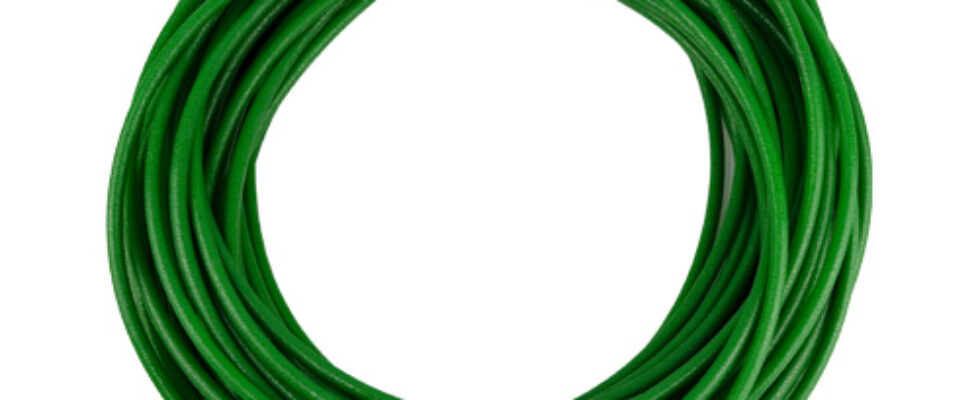
An O ring Drive Belt, sometimes called a round belt, is a flexible, circular cross-section belt made of elastomeric polymers. As its name suggests, it resembles the familiar O-ring seal used in hydraulic and pneumatic systems, but is specifically dimensioned and formulated for power transmission.
O ring Drive Belts are used to transfer rotational force and motion between two or more pulleys—allowing energy from a drive motor to be transmitted to one or more driven components. Unlike flat or V-belts, which have a broad rectangular shape, the O ring Drive Belt’s round profile reduces bending resistance and offers more versatile routing in compact or intricate machinery layouts.
2. How Does an O ring Drive Belt Work?
The operational principle behind the O ring Drive Belt is friction-based, but with unique geometry and material properties. The round cross-section provides naturally low friction on the belt’s sides, but a secure grip in the grooves of specialized pulleys. As the driving pulley turns, it pulls the O ring Drive Belt, which rotates the driven pulley—transmitting power with remarkable smoothness and minimal noise.
Some key aspects of its motion:
Slippage Management: A properly tensioned O ring Drive Belt operates with minimal slippage, even in processes that demand stop-start action or variable speeds.
Multi-directional Routing: Its flexible nature allows for twists, crossovers, or right-angle power transfer—something linear belts cannot achieve as easily.
Tension Control: Light tension is usually sufficient due to the elasticity of the material—reducing bearing loads and wear on machine components.
3. Key Features: Why Choose an O ring Drive Belt?
The O ring Drive Belt stands out for several reasons, especially in precision engineering contexts:
Compactness: Its geometry fits into smaller spaces where other belts cannot.
Quiet Performance: Elastomeric materials and round design minimize noise and vibration.
Gentle Power Transfer: The elasticity provides shock absorption, reducing mechanical stress and protecting fragile transported goods.
Simple Installation: Can often be installed or replaced quickly without disassembling machinery.
Customization: Available in a wide variety of diameters, materials, lengths, and colors—ideal for OEM or repair purposes.
4. Typical Materials and Construction
O ring Drive Belts are most commonly made from:
Polyurethane (PU): Offers excellent abrasion resistance, high flexibility, and chemical stability—ideal for long life and variable environments.
Nitrile Rubber (NBR): Resists oils and grease, making it suitable for food processing and packaging lines.
EPDM and Silicone: Used in high-temperature or special chemical environments.
Special Blends: For antistatic, UV-resistant, or non-marking applications.
Manufacturing methods include extrusion (for seamless endless belts) and joining/welding ends (for custom lengths or field replacements).
5. Core Advantages in Precision Power Transmission
Why do engineers and designers so often turn to the O ring Drive Belt for high-precision needs?
a) Consistency and Accuracy
Because of minimal play (backlash) in the system, O ring Drive Belts transmit rotary motion with dependable repeatability and fine control.
b) Minimal Vibration
The round, elastic nature of the belt dampens vibration, critical where sensitive processes (such as scanning, lab measurements, or micro-assembly) require stability.
c) Smooth, Shock-absorbing Action
O ring Drive Belts can absorb small mechanical shocks, protecting gears and delicate mechanical systems from abrupt load changes.
d) Flexible Configurations
They’re uniquely capable of making sharp turns, passing over multiple pulleys, or performing right-angle power transmission in ways that would be impossible (or highly inefficient) for most larger-section belts.
e) Low Maintenance
With no metal links, lubrication, or heavy tensioning required, these belts deliver exceptional lifecycle economy—especially when made from high-performance materials.
6. Where O ring Drive Belts Shine: Common Applications
The O ring Drive Belt finds use in a surprising range of industries and devices:
Industrial Automation:
Small roller conveyors, diverters, or sorters within packaging and logistics lines.
Precision Laboratory and Medical Equipment:
Pumps, microtomes, centrifuges, robotic pipettes, or analyzers that demand quiet and accurate transmission.
Office Machinery:
Printers, scanners, mail sorting machines, and plotters—all use O ring Drive Belts for reliable, silent paper handling or carriage movement.
Food and Beverage:
Sorting and packaging mechanisms in clean environments, often using food-grade materials.
Textiles:
Yarn winding, thread guides, and other gentle, high-speed operations.
Vending Machines and Kiosks:
Moving trays, shuttles, or rotary mechanisms for reliable, maintenance-light operation.
Their suitability for crossed drives, compact routing, and light-duty applications explains their popularity in precision equipment across industry lines.
7. Choosing the Right O ring Drive Belt for Your Machinery
Diameter and Length: Sizing must match pulley diameters and required center distance, factoring in desired tension and stretch ratio.
Material Selection: Must reflect operating conditions—temperature, humidity, exposure to oils or cleaning agents.
Color Coding: Easy identification may matter for assembly and spare part management.
Application Load: While O ring Drive Belts excel at light to medium-duty work, ensure the cross-section chosen is adequate for your application’s power needs.
We provide engineering support to help clients specify the perfect belt for new equipment or retrofits.
8. Installation Tips: Getting the Most Out of Your O ring Drive Belt
Proper installation and tension are key to optimizing service life:
Avoid Overstretching: Excessive stretch puts extra load on the belt and bearings. Ideal tension is enough to avoid slippage, but not so tight as to deform the belt cross-section.
Guided Routing: Ensure pulleys are aligned and free of sharp edges that could nick the belt.
Clean Pathways: Dirt, dust, or grease can deteriorate the belt or cause slippage.
Twisted Drives: For right-angle power transfer, a 90-degree twist is sometimes employed—but always use manufacturer guidance to prevent excessive lateral stress.
Many O ring Drive Belts are designed to “snap fit” onto pulleys, simplifying installation for repairs and minimizing downtime.
9. Maintenance: Ensuring Longevity and Consistency
Best practices include:
Routine Inspection: Check for cracks, cuts, glazing, or elongation. Replace at intervals or as soon as significant wear is found.
Cleanliness: Wipe belts and pulley grooves periodically.
Storage: Store spare belts out of direct sunlight, away from ozone or harsh chemicals, and in a cool, dry environment to avoid premature aging.
Shanghai Puteken Transmission System Co., Ltd. includes maintenance guidelines with every product to help keep your lines running effortlessly.
10. Why Shanghai Puteken Transmission System Co., Ltd. is Your Ideal Belt Partner
For decades, we have been the supplier of choice for industries that value:
Customization: Order any size, color, or material—even low-volume or specialty requirements.
Quality: Every O ring Drive Belt is manufactured and tested to strict standards for dimensional accuracy, elasticity, and resistance to common industrial hazards. -Global Reach: Fast shipping and sustained support for clients worldwide. -Technical Expertise: Our engineering team assists with belt selection, drive system design, troubleshooting, and custom solutions. -Sustainable Practices: Lead the way with recyclable materials and responsible manufacturing.
Small Belt, Big Impact
In the grand scheme of industrial power transmission, it’s all too easy to overlook the compact, modest O ring Drive Belt. Yet, its contribution to precision, reliability, and operational smoothness is undeniable. With unique geometry, adaptable materials, and nearly universal application potential, this humble component solves big engineering problems every day.
Frequently Asked Questions (FAQ)
Q: What’s the main difference between an O ring Drive Belt and a flat or V-belt?
A: The O ring Drive Belt has a round cross-section and excels at small, lightweight transmissions. Flat belts are best for large-scale, high-efficiency drives, while V-belts suit medium and heavy-duty loads. O ring belts are particularly valued for flexibility and compact routing.
Q: Can O ring Drive Belts handle heavy loads or high torque?
A: They are best for light-to-moderate loads. For heavy-duty applications, consider V-belts or synchronous belts.
Q: How can I calculate the correct length of an O ring Drive Belt?
A: Measure the center distance between pulleys and use supplier-provided formulas. Remember to account for initial stretch; Shanghai Puteken provides calculators and engineering support.
Q: Are O ring Drive Belts suitable for food and medical environments?
A: Yes! We supply FDA, EU, and medical-grade belts upon request with materials that meet strict regulatory standards.
Q: How often should I replace my O ring Drive Belt?
A: Inspect regularly and replace upon signs of wear, stretching, or loss of tension. Typical lifespans range from thousands to tens of thousands of operational hours, varying with environment and load.
Q: Can I order colored O ring Drive Belts for identification?
A: Absolutely. We offer custom colors for both functional distinction and aesthetic alignment with machinery.
Q: What causes most O ring Drive Belt failures?
A: Over-tensioning, contamination from oils or abrasives, and running belts over pulleys that are too small or rough. Correct sizing and preventive maintenance mitigate these risks.
Q: Do you provide technical support for integration or troubleshooting?
A: Yes, our technicians and application engineers are always available—on call, online, or on-site.
Q: What’s the shortest possible production lead time?
A: Many standard O ring Drive Belts are in stock for immediate shipment, and custom runs can often be produced within days.
Q: Can O ring Drive Belts be joined on-site?
A: Yes. Weldable grades are stocked for fast repairs or custom installations, with tools and instructions supplied as needed.
In industries where precision, speed, and smooth operation are crucial—such as logistics, automation, packaging, 3D printing, and light-duty material handling systems—O Ring Drive Belts (also known as round belts) play an essential role in ensuring seamless mechanical motion.
These belts may be compact, but their performance has a significant impact on the efficiency, speed, and reliability of smaller drive systems. Their unique circular cross-section allows for quiet, flexible, and vibration-resistant operation, making them a go-to solution for many OEMs and manufacturing units. However, like any transmission component, the lifespan and performance of an O Ring Drive Belt depend largely on how well it is maintained.
At Shanghai Puteken Transmission System Co., Ltd., we specialize in engineering and supplying high-quality O Ring Drive Belts designed for long-lasting performance across a wide range of industrial applications. Yet, even the finest belt will experience premature wear or failure if proper care and maintenance are ignored.
Understanding the O Ring Drive Belt: A Quick Overview
Also known as round belts, these are circular-section belts typically made from polyurethane (PU), rubber, silicone, or elastomeric composites. They are designed for low to medium-load applications, often in systems requiring:
Low noise operation
Non-slip grip
Shock absorption
Minimal tensioning
These belts are often used in:
Roller conveyor systems
Packaging and labeling machines
Laundry and textile equipment
Diagnostic medical devices
Electronics assembly systems
3D printers and robotics
Their flexibility and ability to twist, stretch, and loop around tight radius pulleys make them ideal for compact, multi-directional configurations.
But with all their benefits come the need for regular inspection, careful handling, and proper operating conditions, which are often overlooked.
Top Maintenance Tips to Maximize O-Ring Drive Belt Performance
Now, let’s explore expert-recommended tips that can help extend the working life of your O Ring Drive Belt, improve machinery uptime, and reduce unnecessary replacements:
1. Choose the Right Belt Material for Your Application
First and foremost, longevity begins with selecting the correct belt material. All materials are suited for all environments.
Material Best Used For Polyurethane (PU) Excellent wear resistance, high elasticity, oils/grease exposure Rubber Good for grip under dry conditions, higher temperature tolerance Silicone Ideal for cleanrooms, food-grade or heat-sensitive environments
Shanghai Puteken Transmission System Co., Ltd. offers a wide range of material customization to help you match your specific environmental and load parameters.
2. Maintain Proper Belt Tension
Incorrect tensioning is the number one cause of belt breakage or performance loss.
Over-tightened belts accelerate wear on both the belt and pulleys, increasing the risk of snapping
Under-tensioned belts may slip, causing speed inconsistencies or reduced torque transfer
Use tensioning tools or a standard tensioning guideline specific to your setup.
Allow the belt to “relax” after installation to stabilize tension before running full loads.
Periodically recheck tension after the first 48–72 hours of continuous operation.
3. Keep Pulleys Clean and Aligned
Misalignment of pulleys causes uneven belt loading, off-track movement, and premature damage to belt edges.
Use a straight edge or laser tool to align pulleys
Ensure bore and shaft tolerances are within manufacturer standards
Regularly clean pulleys with a suitable, non-aggressive cleaner
Debris, oil, or buildup on pulleys can reduce friction and cause belt slippage.
4. Lubrication: Use It Sparingly or Not at All
O Ring Drive Belts typically don’t require lubrication. Excess oil or contaminants can lead to:
Material softening
Swelling or breakdown, especially in PU belts
Slipping and motor overloading
If used in dusty or particulate-heavy environments, keep components dry and clean, and protect rotating parts from external contamination.
5. Perform Regular Inspections
Routine checks should include:
Surface wear or cracking on the belt
Uneven diameter or stretching
Friction burns or discoloration
Edge fraying or rubber “dust” near the motor
Catch issues early and order replacements before critical failure. At Puteken, we offer OEM-grade belts and custom pre-cut lengths for easy replacements.
6. Store Belts Properly
Storage conditions can directly affect the shelf life of O-rings.
Store in cool, dry environments (ideally under 25°C)
Avoid direct sunlight or UV exposure, which degrades rubber
Do not hang belts vertically—it causes stretching. Keep them laid flat or coiled loosely.
7. Avoid Sharp Bends or Twisting During Installation
Although these belts are flexible, sharp bends can cause micro-cracks that worsen over time.
Never pry or twist belts with sharp tools
Preheat difficult installations gently using warm water (if material allows)
Allow for gradual stretching during setup; don’t overstretch
8. Monitor Belt Load and Speed Limits
Operating outside belt specifications often leads to:
Excessive vibration
Belt elongation or bounce
Premature fatigue
Refer to Puteken’s material data sheets for load ratings, speed ranges, and tension specs specific to your belt type.
Benefits of Maintaining Your O Ring Drive Belt
Implementing the tips above brings wide-ranging benefits, including:
Improved machine uptime
Consistent product throughput
Reduced unplanned downtime
Longer motor and bearing life
Better energy efficiency
Lower total cost of maintenance
Good maintenance protects more than just the belt—it enhances the productivity of your entire system.
At Shanghai Puteken Transmission System Co., Ltd., we take pride in offering industrial-grade O Ring Drive Belts designed for durability, consistency, and performance. Here’s why clients across automation, warehousing, packaging, and electronics industries trust us:
Wide material selection: PU, rubber, silicone, and custom blends
Sizes from 2 mm to 18 mm in diameter
Circular endless, welded, or connector-based belts
OEM and custom machining available
Fast delivery and global technical support
Whether you need a standard off-the-shelf belt or a customized solution for your automated line, we’re here to provide guidance, samples, and expert insight.
Maximize Performance, Minimize Downtime
When it comes to your drive system, the humble O Ring Drive Belt plays a vital role that’s too often overlooked—until something goes wrong. By following regular maintenance practices, selecting the right materials, and partnering with a trusted supplier, you can extend belt life, protect equipment, and improve performance across the board.
Frequently Asked Questions (FAQ)
Q1: How long do O Ring Drive Belts typically last?
A: Lifespan varies based on the working environment, load, and maintenance. In clean, moderate-use conditions, belts can last 6–24 months or even longer with preventive care.
Q2: Can I use adhesives or connectors for repair?
A: For emergency fixes, heat-weldable belts can be joined using a hot knife tool or welding jig. However, this may not restore full strength. We always recommend keeping pre-cut backups from Puteken.
Q3: What’s the minimum pulley diameter for O ring belts?
A: Minimum diameter depends on the belt’s material and thickness. For example, a 4 mm PU belt works best with pulleys of at least 20 mm diameter.
Q4: Are food-grade O Ring Drive Belts available?
A: Yes. Silicone and food-safe PU belts are FDA-compliant and available on request with certifications.
Q5: What’s the best way to measure the replacement belt size?
A: Measure:
Center-to-center distance between pulleys
Pulley diameters
Desired tension/stretch (usually 5–8%)
We can assist with calculation upon receiving your machine parameters.