
O Ring Drive Belt: The Unsung Hero of Precision Power Transmission!
In any modern industrial environment, machinery must run smoothly, efficiently, and reliably to keep production on schedule and quality consistent. While operators and engineers often focus on motors, gears, and sensors, there is one essential component that quietly ensures seamless transmission of power—frequently out of sight, but never out of function. That component is the O ring Drive Belt.
Though small and sometimes overlooked, the O ring Drive Belt serves as an essential link in a myriad of mechanical processes. It provides compact, silent, and energy-efficient power transmission in devices ranging from high-speed sorting machines to precision laboratory instruments. By expertly coupling rotating shafts and delivering smooth rotational movement, the O ring Drive Belt minimizes slippage and vibration while maximizing operational accuracy.
1. What is an O ring Drive Belt?
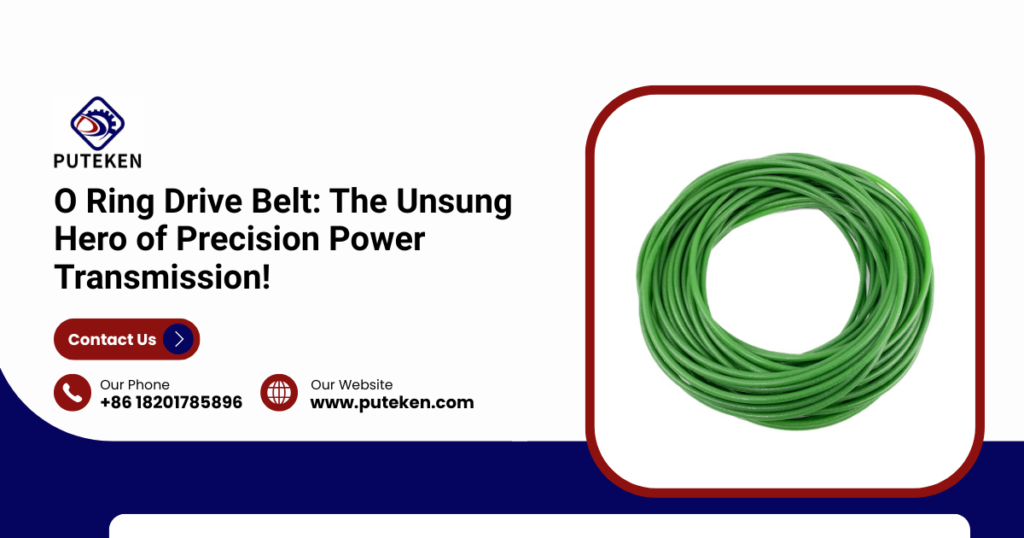
An O ring Drive Belt, sometimes called a round belt, is a flexible, circular cross-section belt made of elastomeric polymers. As its name suggests, it resembles the familiar O-ring seal used in hydraulic and pneumatic systems, but is specifically dimensioned and formulated for power transmission.
O ring Drive Belts are used to transfer rotational force and motion between two or more pulleys—allowing energy from a drive motor to be transmitted to one or more driven components. Unlike flat or V-belts, which have a broad rectangular shape, the O ring Drive Belt’s round profile reduces bending resistance and offers more versatile routing in compact or intricate machinery layouts.
2. How Does an O ring Drive Belt Work?
The operational principle behind the O ring Drive Belt is friction-based, but with unique geometry and material properties. The round cross-section provides naturally low friction on the belt’s sides, but a secure grip in the grooves of specialized pulleys. As the driving pulley turns, it pulls the O ring Drive Belt, which rotates the driven pulley—transmitting power with remarkable smoothness and minimal noise.
Some key aspects of its motion:
- Slippage Management: A properly tensioned O ring Drive Belt operates with minimal slippage, even in processes that demand stop-start action or variable speeds.
- Multi-directional Routing: Its flexible nature allows for twists, crossovers, or right-angle power transfer—something linear belts cannot achieve as easily.
- Tension Control: Light tension is usually sufficient due to the elasticity of the material—reducing bearing loads and wear on machine components.
3. Key Features: Why Choose an O ring Drive Belt?
The O ring Drive Belt stands out for several reasons, especially in precision engineering contexts:
- Compactness: Its geometry fits into smaller spaces where other belts cannot.
- Quiet Performance: Elastomeric materials and round design minimize noise and vibration.
- Gentle Power Transfer: The elasticity provides shock absorption, reducing mechanical stress and protecting fragile transported goods.
- Simple Installation: Can often be installed or replaced quickly without disassembling machinery.
- Customization: Available in a wide variety of diameters, materials, lengths, and colors—ideal for OEM or repair purposes.
4. Typical Materials and Construction
O ring Drive Belts are most commonly made from:
- Polyurethane (PU): Offers excellent abrasion resistance, high flexibility, and chemical stability—ideal for long life and variable environments.
- Nitrile Rubber (NBR): Resists oils and grease, making it suitable for food processing and packaging lines.
- EPDM and Silicone: Used in high-temperature or special chemical environments.
- Special Blends: For antistatic, UV-resistant, or non-marking applications.
Manufacturing methods include extrusion (for seamless endless belts) and joining/welding ends (for custom lengths or field replacements).
5. Core Advantages in Precision Power Transmission
Why do engineers and designers so often turn to the O ring Drive Belt for high-precision needs?
a) Consistency and Accuracy
Because of minimal play (backlash) in the system, O ring Drive Belts transmit rotary motion with dependable repeatability and fine control.
b) Minimal Vibration
The round, elastic nature of the belt dampens vibration, critical where sensitive processes (such as scanning, lab measurements, or micro-assembly) require stability.
c) Smooth, Shock-absorbing Action
O ring Drive Belts can absorb small mechanical shocks, protecting gears and delicate mechanical systems from abrupt load changes.
d) Flexible Configurations
They’re uniquely capable of making sharp turns, passing over multiple pulleys, or performing right-angle power transmission in ways that would be impossible (or highly inefficient) for most larger-section belts.
e) Low Maintenance
With no metal links, lubrication, or heavy tensioning required, these belts deliver exceptional lifecycle economy—especially when made from high-performance materials.
6. Where O ring Drive Belts Shine: Common Applications
The O ring Drive Belt finds use in a surprising range of industries and devices:
Industrial Automation:
Small roller conveyors, diverters, or sorters within packaging and logistics lines.
Precision Laboratory and Medical Equipment:
Pumps, microtomes, centrifuges, robotic pipettes, or analyzers that demand quiet and accurate transmission.
Office Machinery:
Printers, scanners, mail sorting machines, and plotters—all use O ring Drive Belts for reliable, silent paper handling or carriage movement.
Food and Beverage:
Sorting and packaging mechanisms in clean environments, often using food-grade materials.
Textiles:
Yarn winding, thread guides, and other gentle, high-speed operations.
Vending Machines and Kiosks:
Moving trays, shuttles, or rotary mechanisms for reliable, maintenance-light operation.
Their suitability for crossed drives, compact routing, and light-duty applications explains their popularity in precision equipment across industry lines.
7. Choosing the Right O ring Drive Belt for Your Machinery
When selecting an O ring Drive Belt, Shanghai Puteken Transmission System Co., Ltd. recommends considering:
- Diameter and Length: Sizing must match pulley diameters and required center distance, factoring in desired tension and stretch ratio.
- Material Selection: Must reflect operating conditions—temperature, humidity, exposure to oils or cleaning agents.
- Color Coding: Easy identification may matter for assembly and spare part management.
- Application Load: While O ring Drive Belts excel at light to medium-duty work, ensure the cross-section chosen is adequate for your application’s power needs.
We provide engineering support to help clients specify the perfect belt for new equipment or retrofits.
8. Installation Tips: Getting the Most Out of Your O ring Drive Belt
Proper installation and tension are key to optimizing service life:
- Avoid Overstretching: Excessive stretch puts extra load on the belt and bearings. Ideal tension is enough to avoid slippage, but not so tight as to deform the belt cross-section.
- Guided Routing: Ensure pulleys are aligned and free of sharp edges that could nick the belt.
- Clean Pathways: Dirt, dust, or grease can deteriorate the belt or cause slippage.
- Twisted Drives: For right-angle power transfer, a 90-degree twist is sometimes employed—but always use manufacturer guidance to prevent excessive lateral stress.
Many O ring Drive Belts are designed to “snap fit” onto pulleys, simplifying installation for repairs and minimizing downtime.
9. Maintenance: Ensuring Longevity and Consistency
Best practices include:
- Routine Inspection: Check for cracks, cuts, glazing, or elongation. Replace at intervals or as soon as significant wear is found.
- Cleanliness: Wipe belts and pulley grooves periodically.
- Storage: Store spare belts out of direct sunlight, away from ozone or harsh chemicals, and in a cool, dry environment to avoid premature aging.
Shanghai Puteken Transmission System Co., Ltd. includes maintenance guidelines with every product to help keep your lines running effortlessly.
10. Why Shanghai Puteken Transmission System Co., Ltd. is Your Ideal Belt Partner
For decades, we have been the supplier of choice for industries that value:
- Customization: Order any size, color, or material—even low-volume or specialty requirements.
- Quality: Every O ring Drive Belt is manufactured and tested to strict standards for dimensional accuracy, elasticity, and resistance to common industrial hazards.
-Global Reach: Fast shipping and sustained support for clients worldwide.
-Technical Expertise: Our engineering team assists with belt selection, drive system design, troubleshooting, and custom solutions.
-Sustainable Practices: Lead the way with recyclable materials and responsible manufacturing.
Small Belt, Big Impact
In the grand scheme of industrial power transmission, it’s all too easy to overlook the compact, modest O ring Drive Belt. Yet, its contribution to precision, reliability, and operational smoothness is undeniable. With unique geometry, adaptable materials, and nearly universal application potential, this humble component solves big engineering problems every day.
Frequently Asked Questions (FAQ)
Q: What’s the main difference between an O ring Drive Belt and a flat or V-belt?
A: The O ring Drive Belt has a round cross-section and excels at small, lightweight transmissions. Flat belts are best for large-scale, high-efficiency drives, while V-belts suit medium and heavy-duty loads. O ring belts are particularly valued for flexibility and compact routing.
Q: Can O ring Drive Belts handle heavy loads or high torque?
A: They are best for light-to-moderate loads. For heavy-duty applications, consider V-belts or synchronous belts.
Q: How can I calculate the correct length of an O ring Drive Belt?
A: Measure the center distance between pulleys and use supplier-provided formulas. Remember to account for initial stretch; Shanghai Puteken provides calculators and engineering support.
Q: Are O ring Drive Belts suitable for food and medical environments?
A: Yes! We supply FDA, EU, and medical-grade belts upon request with materials that meet strict regulatory standards.
Q: How often should I replace my O ring Drive Belt?
A: Inspect regularly and replace upon signs of wear, stretching, or loss of tension. Typical lifespans range from thousands to tens of thousands of operational hours, varying with environment and load.
Q: Can I order colored O ring Drive Belts for identification?
A: Absolutely. We offer custom colors for both functional distinction and aesthetic alignment with machinery.
Q: What causes most O ring Drive Belt failures?
A: Over-tensioning, contamination from oils or abrasives, and running belts over pulleys that are too small or rough. Correct sizing and preventive maintenance mitigate these risks.
Q: Do you provide technical support for integration or troubleshooting?
A: Yes, our technicians and application engineers are always available—on call, online, or on-site.
Q: What’s the shortest possible production lead time?
A: Many standard O ring Drive Belts are in stock for immediate shipment, and custom runs can often be produced within days.
Q: Can O ring Drive Belts be joined on-site?
A: Yes. Weldable grades are stocked for fast repairs or custom installations, with tools and instructions supplied as needed.