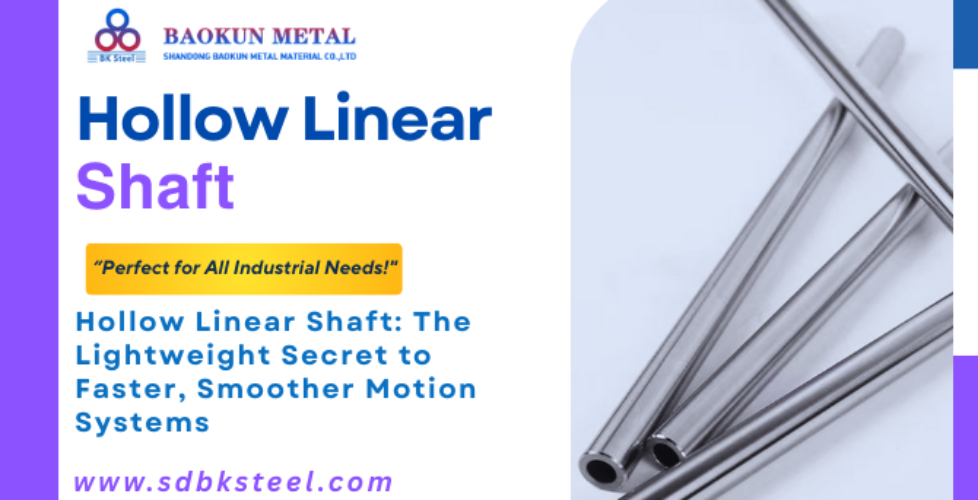
Hollow Linear Shaft: The Lightweight Secret to Faster, Smoother Motion Systems
In modern automation, speed and precision are no longer optional; they are fundamental design criteria. Yet as engineers push machines to move faster, accelerate harder, and position more accurately, a familiar obstacle continually appears: mass. Every extra kilogram in a moving assembly makes it harder to reach higher speeds, to maintain tight tolerances, and to keep energy consumption under control.
This is exactly where the Hollow Linear Shaft has become a quiet but powerful engineering solution. By intelligently removing material from the center of a shaft—where it contributes least to stiffness—engineers can significantly reduce weight without sacrificing essential strength. As a result, machines run faster, smoother, and more efficiently.
At Shandong Baokun Metal Material Co., Ltd., we see this design shift every day. Our industrial customers—from CNC machine builders to manufacturers of packaging lines, medical equipment, and automated storage systems—are increasingly looking for ways to reduce mass in their motion systems without compromising reliability. The Hollow Linear Shaft has moved from a niche option to a mainstream design choice for exactly this reason.
Why Weight Matters So Much in Linear Motion?
Before discussing the Hollow Linear Shaft itself, it is important to understand why weight reduction has become a central design priority in motion systems.
1. Inertia and Acceleration
Whenever a linear system starts, stops, or changes direction, the drive mechanism—whether a motor, pneumatic cylinder, or linear actuator—must overcome inertia. Inertia is directly proportional to mass. Consequently, the heavier the moving parts, the more force and energy are needed to accelerate and decelerate them.
By replacing a solid shaft with a hollow linear shaft, you substantially reduce that mass. Therefore:
2. Vibration, Deflection, and Positioning Accuracy
These factors can degrade repeatability and positioning accuracy, particularly in precision applications like CNC machines and measuring equipment. Because a Hollow Linear Shaft maintains most of its bending stiffness while significantly reducing weight, it helps minimize sag and dynamic vibration. As a result, the system can maintain smoother motion and tighter tolerances.
3. Energy Efficiency and Operating Costs
Overall power requirements decrease, reducing long-term operating costs.
For large automated lines with many axes, the cumulative energy savings of lightweight components like the Hollow Linear Shaft can be substantial over the lifetime of the equipment.
What Is a Hollow Linear Shaft?
At its core, a Hollow Linear Shaft is exactly what the name suggests: a cylindrical shaft with a precision hole along its axis, designed to guide linear bearings, bushings, or carriages in a motion system.
However, the details matter. Let’s break down what defines a high-quality Hollow Linear Shaft.
Basic Construction:
A typical Hollow Linear Shaft used in automation features:
- Outer Diameter (OD): Ground to a precise, uniform size to match common linear bearing standards.
- Inner Diameter (ID): A concentric bore reduced to a specific wall thickness.
- Material: Commonly medium carbon steel, alloy steel, or stainless steel, depending on application needs.
- Surface Treatment: Often induction-hardened and chrome-plated for wear resistance and low friction, or made from corrosion-resistant stainless steel.
- Surface Finish: Fine ground finish to ensure smooth bearing travel and reduced friction.
The bore is carefully controlled during manufacturing so that wall thickness remains consistent. This ensures the Hollow Linear Shaft has predictable stiffness and strength along its length.
How It Differs from a Solid Shaft?
Mechanically, the main difference is that material near the shaft center is removed. Importantly, material at the outer surface carries most of the bending and torsional loads. Therefore, removing material from the center:
Hollow vs. Solid: Engineering Trade-offs
When deciding between a solid and a hollow linear shaft, engineers balance several factors. Understanding these trade-offs helps you determine when a Hollow Linear Shaft is the right choice.
1. Weight and Inertia
Solid Shaft: Maximum weight for a given outer diameter.
Hollow Linear Shaft: Weight reduced by the volume of the bore, which can easily be 20–50% depending on wall thickness.
The reduction in rotating or translating mass directly cuts inertia. Consequently, actuators and motors can be downsized or can provide better performance at the same size.
2. Bending Stiffness and Deflection
A common concern is whether hollow shafts are “weaker” or more flexible than solid ones. The reality is more nuanced:
Bending stiffness depends largely on the outer diameter and the moment of inertia of the cross-section.
By keeping the same OD and introducing a moderate bore, you only reduce the moment of inertia to a limited extent.
For many designs, the resulting deflection still falls well within acceptable limits.
In other words, for many spans and load conditions, a Hollow Linear Shaft offers stiffness that is close to a solid shaft of the same OD, but at much lower weight.
3. Load Capacity
Because bending stiffness and stress resistance change slightly, the maximum recommended load (especially for long, unsupported spans) may be somewhat lower for hollow shafts.
4. Dynamic Behavior and Vibration
Interestingly, the lower mass of a Hollow Linear Shaft often improves dynamic behavior:
Less mass reduces the energy of vibrations.
The system can settle more quickly after a move.
Resonance frequencies may shift in a way that benefits overall performance.
Therefore, in high-speed motion, hollow shafts can actually contribute to smoother, more stable operation.
5. Cost Considerations
The cost comparison is not always straightforward:
Hollow shafts may be slightly more expensive per unit length due to more complex manufacturing and processing.
However, they can enable smaller motors, lighter frames, and reduced energy consumption, which can significantly lower total system cost.
For many OEMs, the long-term economic benefits of improved throughput and lower operating costs justify the marginal increase in component price—if any.
Key Benefits of Hollow Linear Shafts in Motion Systems:
Once you weigh the trade-offs, the advantages of a Hollow Linear Shaft become clear. Let’s summarize the most important benefits.
1. Reduced Moving Mass
The most obvious benefit is the reduction in moving mass:
- Enables faster acceleration and deceleration
- Decreases motor torque requirements
- Minimizes wear on drive components (belts, screws, couplings)
Consequently, the overall life of the system can be extended, and performance can be significantly improved.
2. Higher Speed and Throughput
With less inertia to overcome, your motion system can:
- Reach higher travel speeds,
- Complete positioning moves in shorter cycle times, and
Increase the number of operations per hour.
This is especially valuable in high-volume production environments where even small time savings per cycle translate into large productivity gains.
3. Smoother Motion and Better Precision
Because Hollow Linear Shafts combine relatively high stiffness with low mass:
- Dynamic deflections are reduced.
- Vibrations settle faster after movement.
- Smoothness of linear bearing travel is enhanced due to consistent surface quality and hardness.
Therefore, precision applications like CNC routers, inspection equipment, laser cutters, and semiconductor tools can benefit substantially.
4. Improved Energy Efficiency
Every watt saved in drive power contributes to lower operating costs and a smaller environmental footprint. By reducing shaft mass, Hollow Linear Shafts:
- Lower energy demand per motion cycle,
- Allow the use of smaller, more efficient motors, and
- Reduce heat generation in drives and control cabinets.
Over years of continuous operation, this can represent a significant cost advantage.
5. Easier Handling, Assembly, and Maintenance
In addition, the lighter weight of Hollow Linear Shafts simplifies:
- Manual handling during installation, particularly for long shafts.
- Mounting and alignment tasks, due to the reduced risk of bending under their own weight.
- Maintenance and replacement, since technicians can work more safely and quickly with lighter components.
This is especially useful where shafts must be installed at height or in tight spaces.
6. Additional Functional Uses of the Bore
Finally, the central bore of a Hollow Linear Shaft is not just a way to save weight; it can also serve functional purposes:
- Routing of cables, pneumatic tubes, or fluid lines through the shaft
- Integration of sensor wiring for encoders or limit switches
- Accommodation of vacuum lines or lubrication supply lines
This allows more compact and integrated designs, which are very attractive for modern, space-efficient machines.
Typical Applications for Hollow Linear Shafts
Given these advantages, the Hollow Linear Shaft is now used across a wide range of industries. Some common applications include:
- CNC Machinery and Routers
For gantry axes, Z-axes, and tool changers, where rapid and precise positioning is essential. - 3D Printers and Additive Manufacturing Systems
Especially in large-format printers, where long shafts benefit greatly from reduced weight. - Pick-and-Place and Assembly Automation
For high-speed transfer systems, component insertion, and electronic assembly machinery. - Packaging and Labeling Equipment
In high-throughput lines, where light, fast-moving components are critical to productivity. - Material Handling and Automated Storage Systems
For shuttles, stacker cranes, and small robots moving at high speeds. - Medical and Laboratory Devices
Where smooth, vibration-free motion is necessary for precision and user comfort. - Inspection, Measuring, and Testing Equipment
Where repeatability and low vibration directly influence measurement accuracy.
In all these cases, a Hollow Linear Shaft allows designers to meet demanding performance targets while minimizing machine bulk and energy use.
Design Considerations When Specifying a Hollow Linear Shaft
To fully benefit from using a Hollow Linear Shaft, you need to select and design it correctly. The following factors should be carefully reviewed.
1. Outer Diameter and Wall Thickness
As a general guideline, choose the largest OD that fits your space and bearing requirements, then select a bore size that provides a good compromise between weight savings and stiffness. Engineering calculations or simple beam deflection tools can help fine-tune this choice.
2. Material Selection
Common material options include:
- Carbon Steel / Alloy Steel:
High strength, induction hardenable, often used with chrome plating. Suitable for most industrial applications. - Stainless Steel:
Provides corrosion resistance for food, medical, marine, or humid environments. Used where cleanliness and durability are critical. - Special Alloys (on request):
For high-temperature, highly corrosive, or particularly demanding conditions.
Shandong Baokun Metal Material Co., Ltd. can help you match material properties to your specific application requirements.
3. Surface Hardness and Finish
The lifespan and smooth operation of a Hollow Linear Shaft depend heavily on:
- Surface hardness: Typically increased through induction hardening (for steels) to resist wear and indentation.
- Surface finish: A fine, ground finish reduces friction and noise and improves the life of linear bearings.
In applications with high duty cycles, selecting the correct hardness and finish quality dramatically extends service life and reduces maintenance.
4. Length and Support Conditions
Shaft length and how it is supported are critical:
- Unsupported Shafts:
For long spans, even a solid shaft can deflect significantly. A Hollow Linear Shaft must be carefully sized to keep deflection within acceptable limits. - Supported Shafts:
When the shaft is supported along its length (for example, mounted on a support rail), a hollow design is often ideal, because the support reduces deflection and the weight savings become more important.
Consequently, you should always consider support configuration together with shaft diameter and wall thickness.
5. Bearing Compatibility
Linear bearings, bushings, and carriages are typically designed to match standard shaft diameters and tolerances:
Verify that the nominal OD of your Hollow Linear Shaft matches your chosen bearing series.
Ensure that tolerances and roundness meet bearing manufacturer recommendations.
At Shandong Baokun, we maintain precision grinding and quality control processes to ensure compatibility with common bearing brands and standards.
6. Environment and Corrosion Resistance
Application environment also impacts shaft selection:
- Humid or washdown environments:
Consider stainless steel Hollow Linear Shafts or corrosion-resistant coatings. - Dusty or abrasive environments:
Ensure strong surface hardness and consider protective wipers or seals on bearings. - Cleanroom or medical environments:
Demand low particle generation, high cleanliness, and often stainless materials.
Accordingly, your environment should be part of the early specification process.
How Shandong Baokun Metal Material Co. Ltd Supports Your Hollow Shaft Needs
Choosing the right Hollow Linear Shaft is not only a matter of theory; it also requires reliable sourcing, consistent quality, and flexible customization.
As a specialized metal material supplier, Shandong Baokun Metal Material Co. Ltd focuses on:
- Material and Process Control
We source suitable steels and stainless steels and apply controlled processes such as heat treatment, surface hardening, and precision grinding to achieve your specified properties.
Dimensional Accuracy and Surface Quality
Our production is geared towards maintaining tight tolerances on:
- Outer and inner diameters
- Straightness over length
- Roundness and concentricity
- Surface roughness
These factors are crucial for long bearing life and smooth motion.
- Customization Options
In many cases, off-the-shelf shafts do not perfectly meet design needs. Therefore, Shandong Baokun can provide: - Custom lengths
Special diameters and wall thicknesses (within feasible ranges)
Machined ends (threads, keyways, flats, mounting features)
Special surface treatments or coatings
Application-Oriented Support
Our team works closely with customers to: - Understand load and speed requirements
Suggest appropriate materials and dimensions
Coordinate with your bearing and component choices
This combination of technical understanding and flexible production helps ensure that your chosen Hollow Linear Shaft performs as expected in real-world operation.
Moving Toward Faster, Lighter, and More Efficient Motion Systems
As automation evolves, engineers are under pressure to design machines that are not only faster and more precise but also energy-efficient and cost-effective. The Hollow Linear Shaft is a deceptively simple yet powerful tool in meeting these demands. Strategically removing unnecessary mass while preserving key mechanical properties, it allows machine designers to unlock higher performance without adding complexity.
Whether you are upgrading an existing system or designing a new platform from scratch, it is worth evaluating how Hollow Linear Shafts can contribute to your goals. With thoughtful selection and a reliable supplier such as Shandong Baokun Metal Material Co. Ltd, you can leverage this lightweight technology to build motion systems that are faster, smoother, and more efficient—while maintaining the reliability your operations depend on.
Frequently Asked Questions (FAQ) About Hollow Linear Shafts
1. What exactly is a Hollow Linear Shaft?
A Hollow Linear Shaft is a cylindrical shaft with a precisely machined central bore, used as a guide for linear bearings, bushings, or carriages in motion systems. It provides most of the stiffness of a solid shaft of the same outer diameter, but with significantly reduced weight and inertia.
2. When should I choose a Hollow Linear Shaft instead of a solid shaft?
You should consider a Hollow Linear Shaft when:
- Your system needs higher speeds or accelerations.
- You want to reduce motor size or energy consumption.
- The shaft is part of a moving assembly, such as a gantry or sliding axis.
- You require longer lengths and wish to minimize sag without excessively increasing shaft diameter.
However, if loads are extremely high and space is limited, a solid shaft may still be the better choice.
3. Are Hollow Linear Shafts as strong as solid shafts?
For the same outer diameter, a Hollow Linear Shaft has somewhat lower bending stiffness and strength than a solid shaft, because some material is removed from the center. Nevertheless, since most of the working stress is carried near the outer surface, the reduction is not as large as many assume.
In many applications, a properly sized Hollow Linear Shaft offers more than sufficient strength while providing substantial weight savings and dynamic benefits.
4. Do Hollow Linear Shafts deflect more than solid ones?
Yes, for the same outer diameter and load, a Hollow Linear Shaft will deflect slightly more than a solid shaft. However:
- If you adjust the shaft diameter, support spacing, or bearing arrangement accordingly, deflection can be kept within acceptable limits.
- In supported-shaft designs, the stiffness difference is often negligible in practice.
Therefore, the actual impact on system performance is usually small when the shaft is correctly selected.
5. Are Hollow Linear Shafts more expensive?
Per unit length, Hollow Linear Shafts can be comparable or slightly higher in cost than solid shafts due to more complex manufacturing. However, they can reduce total system cost by:
- Allowing smaller, more efficient motors and drives
- Reducing wear on components
- Improving throughput and energy efficiency
When you evaluate the total cost of ownership, Hollow Linear Shafts frequently offer a favorable economic advantage.
6. Can I use standard linear bearings on a Hollow Linear Shaft?
Yes. Hollow Linear Shafts are manufactured with the same external dimensions and tolerances as equivalent solid shafts. As long as the shaft OD and tolerance class match the bearing manufacturer’s specifications, standard linear bearings and bushings will work properly.
At Shandong Baokun Metal Material Co., Ltd., we ensure that our Hollow Linear Shafts are compatible with common bearing systems used across the industry.
7. How long can a Hollow Linear Shaft be?
The maximum practical length depends on:
- Shaft diameter and wall thickness
- Material selection and heat treatment
- Straightness tolerances and shipping constraints
8. Can the bore in a Hollow Linear Shaft be used for cables or air lines?
Yes. One of the advantages of a Hollow Linear Shaft is that the central bore can be used to route cables, pneumatic lines, or fluid tubes. This can simplify machine design, protect sensitive lines from damage, and create a cleaner overall assembly.
Be sure to consider the bore size and any necessary end machining to accommodate connectors or fittings.
9. How do I maintain a Hollow Linear Shaft?
Maintenance procedures are very similar to those for solid shafts:
- Keep the shaft surface clean to prevent contamination from damaging bearings.
- Use appropriate lubrication, either via bearing-integrated lubrication or external systems.
- Periodically inspect for wear, corrosion, or damage.
The internal bore itself typically requires little to no direct maintenance unless used for fluid or cable routing.
10. How can Shandong Baokun Metal Material Co., Ltd. help with Hollow Linear Shaft selection?
Shandong Baokun can support you by:
- Recommending suitable diameters, materials, and wall thicknesses based on your load and span conditions.
- Providing engineering input on deflection, stiffness, and dynamic behavior.
Supplying customized Hollow Linear Shafts with specific lengths, end machining, and surface treatments. - Ensuring consistent quality, straightness, and surface finish to match your linear bearing requirements.
By involving us early in your design process, you can streamline component selection and reduce risks during prototyping and production.