
Unlock Precision: How a CNC Rotary Table Can Revolutionize Your Machining Workflow!
In the ever-evolving landscape of modern machining, precision and efficiency are no longer luxuries—they are absolute necessities. As manufacturing industries push the boundaries of innovation and speed, the demands placed on computer numerical control (CNC) systems have increased exponentially. One tool, in particular, has become indispensable in meeting these demands: the CNC Rotary Table.
At SilverCNC, we specialize in providing high-performance machining accessories that enhance the capabilities of CNC machines. Among our most transformative products is the CNC Rotary Table, a tool that introduces a 4th axis into your machining workflow, adding powerful flexibility and precision. Whether you’re a small job shop or a large-scale manufacturing facility, integrating a high-quality CNC Rotary Table can significantly improve your operational efficiency, reduce cycle times, and expand the geometric complexity of parts you can produce.

What is a CNC Rotary Table?
To understand the full potential of a CNC Rotary Table, it’s essential to first know what it is and how it functions within a CNC machining center.
A CNC Rotary Table is a precision work positioning device that allows rotation of the workpiece around a single axis, typically described as the 4th axis (in addition to the standard X, Y, and Z axes). It enables complex angular machining, such as drilling, milling, and contouring on curved surfaces. Depending on the design, CNC Rotary Tables can be used horizontally or vertically and can be integrated directly into the machine’s controller.
Modern CNC rotary tables are powered by servo motors or stepper motors for high positioning accuracy and repeatability. When paired with the automatic control system of CNC machines, they allow the production of highly intricate and multi-faceted parts without repositioning the workpiece—saving time, labor, and potential material waste.
Key Features of SilverCNC’s CNC Rotary Tables
At SilverCNC, we design our rotary tables with the highest precision standards and robust performance in mind. Here are some standout features you can expect from our CNC Rotary Tables:
-High Radial and Axial Load Capacity: Suitable for heavy-duty machining applications.
-Zero Backlash Gear System: Ensures smooth and accurate rotation.
-Servo or Direct Drive Options: Offers flexibility based on application needs.
-Repeatability Within Microns: Critical for parts requiring extremely high precision.
-Durable Construction: Made with high-grade alloy steel for long service life.
-Easy Integration: Designed to work seamlessly with most CNC controllers and systems.
How a CNC Rotary Table Enhances Your Machining Workflow
1. Adds a 4th Axis for Complex Operations
One of the most immediate benefits of using a CNC Rotary Table is the introduction of a fourth axis. This additional axis allows for the machining of complex components in a single setup, dramatically improving operational efficiency. Without a rotary table, multiple reworkings and repositioning would be necessary.
By rotating the workpiece accurately, you can machine features on multiple sides, angles, or contours without interrupting the setup. This is particularly beneficial for industries such as aerospace, mold making, and medical devices, where intricate geometries are common.
2. Reduces Setup Time and Operator Intervention
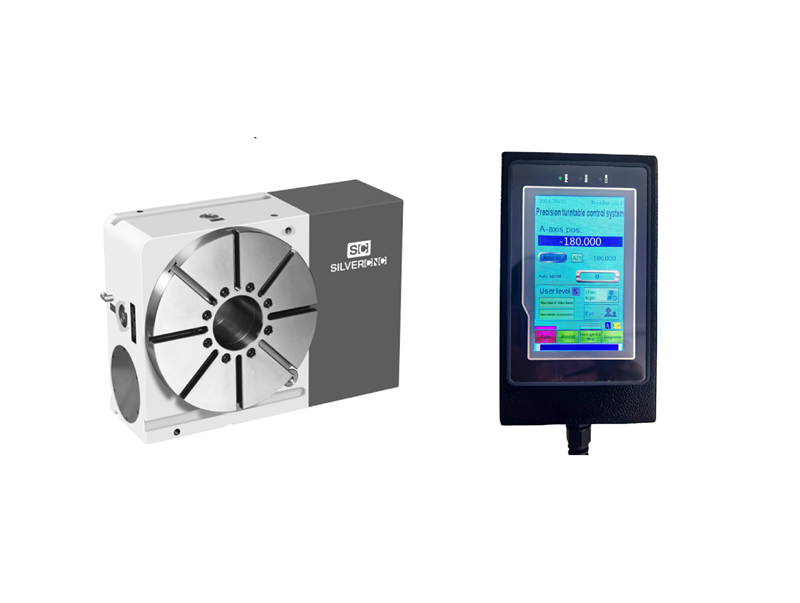
Every time an operator repositions a workpiece manually, it adds time and introduces risk for misalignment or error. The CNC Rotary Table reduces or eliminates the need for re-fixturing. By automating rotational movement, your process becomes smoother, faster, and far more accurate.
Over the course of a production cycle, this saves significant labor hours and reduces downtime, directly impacting your bottom line.
3. Improves Surface Finish and Accuracy
Rotary tables eliminate the need for stopping and shifting, thereby reducing vibration or misalignment caused by manual handling. This contributes to superior surface finishes, fewer tool marks, and consistency across large batch runs.
Moreover, the rotary axis allows for simultaneous multi-axis contouring, especially valuable when creating rounded or curved parts, such as turbine blades or medical implants.
Also Read: The Benefits of Using CNC Rotary Table Index Table [Infographic]
4. Enables Automation and Lights-Out Machining
As industries move toward smart manufacturing and unmanned production, integrating components like CNC Rotary Tables becomes critical. SilverCNC rotary tables are compatible with most CNC automation systems, enabling 24/7 operation and enhancing throughput capacity beyond traditional setups.
5. Versatility across Industries
A CNC Rotary Table isn’t just for high-complexity applications. Its versatility makes it suitable across a wide spectrum of industries:
- Aerospace: For machining engine components and turbine parts.
- Automotive: For engine casings, transmission parts, and brake systems.
- Medical: For orthopedic implants or surgical tools requiring high precision.
- Tool & Die Making: For accurate mold and die components.
- General Manufacturing: For batch production of precision components.
Choosing the Right CNC Rotary Table for Your Machine
Not all rotary tables are created equal. Here are some key factors to consider when selecting the perfect CNC Rotary Table for your operations:
a) Size and Load Capacity
Determine the size and weight of the workpieces you’ll be machining. The rotary table should handle the maximum load without compromising on performance or repeatability.
b) Drive Type: Worm Gear vs. Direct Drive
- Worm Gear Tables are ideal for high torque applications and cost-effective solutions.
- Direct Drive Tables offer faster indexing speeds and exceptional repeatability for advanced machining needs.
c) Accuracy and Repeatability
Evaluate the table’s backlash, angular positioning precision, and overall machine tolerance levels. SilverCNC rotary tables are engineered with near-zero backlash systems and guaranteed micron-level repeatability.
d) Control Compatibility
Ensure the rotary table is compatible with your CNC controller (e.g., FANUC, Siemens, Mitsubishi). SilverCNC offers plug-and-play solutions that integrate without custom coding or extensive modifications.
e) Orientation Options
Some tables are better suited for horizontal mounting, while others offer vertical or multi-position flexibility. Make sure it aligns with your machine’s layout and workholding needs.
Real-World Use Case: Increasing Output with a 4th Axis Setup
A medium-sized aerospace job shop using 3-axis vertical machining centers approached SilverCNC in search of improved cycle times and reduced part errors. By integrating our high-precision CNC Rotary Table, configured as a 4th axis, the shop was able to:
- Reduce setup time by 40%
- Increase throughput by 30%
- Eliminate secondary operations for complex geometries
- Achieve consistent tolerances within ±0.002 mm
The investment paid for itself in just under six months through faster production and higher-quality output.
Maintenance Tips for Your CNC Rotary Table

To keep your rotary table performing at peak levels, regular maintenance is essential. Here are a few tips:
- Lubricate all moving parts based on the manufacturer’s instructions.
- Inspect for backlash regularly and fine-tune gears if necessary.
- Clean seals and surfaces to prevent contaminant buildup.
- Check servo motor health during scheduled machine checks.
- Store idle rotary tables in dry, clean environments to prevent corrosion.
SilverCNC rotary tables are engineered for easy maintenance, with modular components and accessible service points.
Precision is the Future — Are You Ready?
In today’s competitive manufacturing arena, standing still means falling behind. A CNC Rotary Table is one of the smartest investments you can make to stay ahead. By unlocking a new dimension of precision, speed, and flexibility, you not only expand your capabilities but also future-proof your shop for complex, high-value machining.
Frequently Asked Questions (FAQ)
Q1: What’s the difference between a 4th axis and a rotary table?
The terms are often used interchangeably. However, a CNC Rotary Table becomes a 4th axis when it’s motorized and integrated into the CNC’s control system. Manual rotary tables need manual adjustment and are not automated.
Q2: Can I retrofit a CNC Rotary Table to an existing machining center?
Absolutely. SilverCNC’s rotary tables are designed for seamless retrofit onto most vertical and horizontal machining centers. Our support team also provides integration assistance.
Q3: What types of workpieces benefit most from a CNC Rotary Table?
Parts that require angular holes, circular patterns, curved surfaces, or machining on multiple sides benefit the most. Examples include impellers, camshafts, gears, and complex aluminum housings.
Q4: Is the CNC Rotary Table compatible with all CNC controllers?
Most are, but control compatibility should be confirmed during purchase. SilverCNC offers models tailored to major CNC platforms like FANUC, Siemens, and Haas.
Q5: How long does it take to see ROI after investing in a rotary table?
Return on investment varies by workload and product mix, but many customers report full payback within 6 to 12 months due to increased productivity, reduced setups, and fewer rejected parts.