Mastering Thermal Management: How an IGBT Cold Plate Keeps Power Electronics Cool
In the rapidly evolving landscape of high-efficiency power electronics, managing heat effectively is one of the greatest engineering challenges. From electric vehicles (EVs) and renewable energy systems to motor drives and industrial automation, today’s power systems rely heavily on IGBT (Insulated Gate Bipolar Transistor) modules to switch and control high voltages and currents. However, with high power density comes high heat generation, posing serious risks to performance, reliability, and component lifespan. That’s where the IGBT cold plate plays a crucial role.

At Tone Cooling Technology Co., Ltd., we specialize in advanced thermal solutions that meet the rigorous demands of modern electronics. Among these, our custom-designed and thoroughly tested IGBT cold plates lead the industry in enabling next-generation power conversion systems.
Whether you’re an electrical design engineer, system integrator, or technical buyer seeking effective thermal control, this article will give you deeper insight into how the IGBT cold plate functions as a cornerstone of efficient thermal management in high-power applications.
Understanding the IGBT and Its Thermal Challenges
What is an IGBT?
An Insulated Gate Bipolar Transistor (IGBT) is a semiconductor device widely used in power electronics for high-efficiency switching. Popular in applications requiring fast switching and high-voltage handling, IGBTs are key components in:
- Inverters for electric vehicles (EVs)
- Solar and wind power systems
- Uninterruptible power supplies (UPS)
- Industrial motor drives
- Railway traction systems
While IGBTs are highly efficient, they are not immune to one critical constraint: heat. Every time an IGBT switches on or off, energy is lost as heat, particularly at high switching frequencies and under heavy loads.
Why Heat is a Problem
Poor thermal management in IGBT modules can lead to:
- Thermal Runaway – Elevated temperatures increase the current flow, which in turn generates more heat, leading to device failure.
- Reduced Efficiency – When IGBTs operate beyond their ideal temperature, electrical losses increase.
- Component Degradation – Heat stresses solder joints, substrates, and encapsulants, reducing system lifespan.
- Limited Performance – To avoid overheating, systems may throttle performance or restrict current, compromising efficiency.
Therefore, thermal management is not just about heat dissipation—it’s a performance enabler.
Enter the IGBT Cold Plate: A Precision Cooling Solution
What is an IGBT Cold Plate?
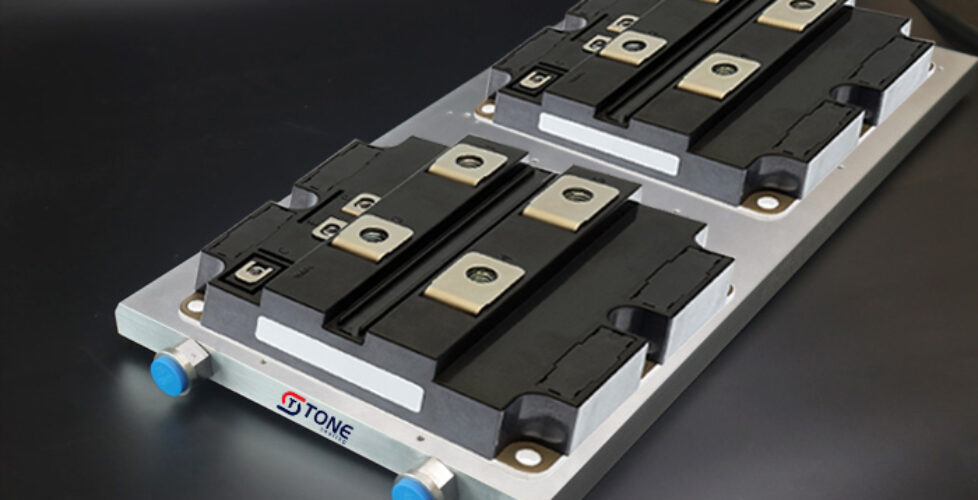
An IGBT cold plate is a specialized liquid cooling component designed to extract and dissipate heat away from the IGBT modules quickly and efficiently. Placed in direct contact with the IGBT’s baseplate or thermal interface layer, the cold plate channels liquid coolant through internal passages under the heated areas.
Here’s how it generally works:
- Heat Transfer Surface – The base of the IGBT is mounted onto the flat surface of the cold plate with thermal interface material (TIM).
- Coolant Flow – A liquid (usually water or dielectric fluid) circulates inside internal microchannels or flow paths within the cold plate.
- Heat Absorption – The moving liquid absorbs the heat generated by the IGBT.
- Heat Rejection – The warmed-up coolant is then directed to a heat exchanger (e.g., radiator or chiller), effectively rejecting the heat into the environment.
Advantages of Using a Cold Plate for IGBT Cooling
- Higher Thermal Conductivity – Liquid coolants carry heat far more efficiently than air, enabling much higher power dissipation per unit area.
- Compact Size – Liquid cooling allows IGBT assemblies to remain compact without compromising heat removal, ideal for systems with limited space.
- Temperature Uniformity – Cold plates maintain consistent temperatures, reducing thermal gradients that cause stress and failure over time.
- Performance and Longevity – Adequate cooling preserves IGBT module lifespan, reliability, and overall system uptime.
- Silent Operation – Unlike high-speed fans, cold plates enable quieter systems, especially important in electric vehicles and indoor installations.
At Tone Cooling Technology Co., Ltd., we engineer customized IGBT cold plate systems using deep thermal simulation and validation methods to meet exact customer and application requirements.
Types of IGBT Cold Plates
Not all cold plates are created equal. Designs vary based on:
- Coolant Type
- Flow Direction
- Cooling Demand
- Mounting Configuration
Here are some of the most common designs:
1. Serpentine Flow Cold Plate
- Coolant moves in a single channel winding through the base
- Simple and cost-effective
- Best for small IGBT module arrays
2. Parallel Microchannel Cold Plate
- Fine channels increase surface area for maximum heat transfer
- Great for high-density and high-power IGBT setups
- Offers low-pressure drop and excellent temperature uniformity
3. Jet Impingement Cold Plate
- Narrow liquid jets directly target hot zones under the IGBT
- High cooling efficiency under heavy loads
- Somewhat more complex and expensive
4. Manifold Cold Plate
- Coolant is distributed evenly across multiple zones
- Ideal for multi-module cooling
- Lower risk of hotspots
At Tone Cooling Technology Co., Ltd., we offer each of these designs and more—to suit your unique thermal challenge.
Design Considerations for Optimal IGBT Cold Plates
Designing an effective IGBT cold plate goes beyond simply creating a metal block with water channels. Several technical parameters require fine-tuned balancing:
1. Thermal Resistance
- Lower thermal resistance means better heat evacuation
- Influenced by base thickness, channel design, and flow rate
2. Pressure Drop
- High pressure drop limits flow and stresses pumps
- The goal is to achieve high heat transfer with minimal pressure burden
3. Material Selection
- Copper and aluminum are used depending on weight, cost, and conductivity requirements
- Surface treatments enhance corrosion resistance and flow efficiency
4. Coolant Compatibility
- Compatibility with deionized water, glycol mixes, or dielectric fluids is essential
- Chemical stability ensures long-term effectiveness and prevents clogging or corrosion
5. Mechanical Reliability
- Cold plates must withstand thermal cycling, vibration, and mechanical stress
- Proper gasketing and sealing protect against leaks
Tone Cooling engineers employ CFD simulation, thermal modeling, and real-world testing to meet target specifications for every cold plate.
Industries and Applications Benefiting from IGBT Cold Plates
The global shift toward electrification, automation, and renewable energy has made IGBT cold plates indispensable for many sectors:
1. Electric Vehicles (EVs)
- EV power inverters and converters rely on IGBTs for drive systems
- Cold plates maintain optimal temperature to prevent power derating
2. Wind and Solar Inverters
- Efficient thermal management in inverters ensures stable operation and long-term yield
3. Industrial Motor Drives
- Motors running on variable-speed drives generate significant heat through switching losses
- Proper cooling enhances accuracy and efficiency
4. HVDC Power Transmission
- In HVDC substations, massive IGBT arrays modulate and rectify current
- Cold plates ensure redundancy and continuous operation
5. Railway and Mass Transit
- In traction systems and dynamic braking, large IGBT modules must remain cool under high power
Why Tone Cooling Technology Co., Ltd. is a Trusted Leader
At Tone Cooling Technology Co., Ltd., we are more than just a manufacturer—we are a thermal engineering partner. Our strengths include:
- In-house Design: Custom cold plate layouts matched to your IGBT module specs
- Precision Manufacturing: CNC-machined channels, brazed joints, and leak-proof sealing
- Testing and Validation: Thermal shock, fatigue, flow, and pressure testing
- Materials Expertise: Copper, aluminum, and hybrid materials available
- Lifecycle Optimization: Solutions built to withstand harsh environments and long duty cycles
We support not only IGBT cooling but also full liquid loop system integration—including pumps, chillers, heat exchangers, and monitoring systems.
Innovation Runs Cool with IGBT Cold Plates
As power electronic systems become more energy-dense and application-critical, effective cooling becomes the difference between success and failure. A reliable IGBT cold plate is not just a supporting component—it is a core thermal enabler that protects your investment, optimizes system performance, and ensures longevity.
From high-speed trains to wind farms and EVs, the cold plate serves as a silent but powerful partner, tirelessly managing heat under intense operating conditions.
FAQs on IGBT Cold Plates
Q1: What is the typical lifespan of an IGBT cold plate?
A: With proper maintenance and fluid management, the cold plates can last 10–15 years or more, even longer in controlled environments.
Q2: Can IGBT modules be air-cooled instead?
A: Yes, for low to moderate power loads, air cooling may suffice. However, for high-voltage, high-current designs, liquid cooling via a cold plate offers superior thermal performance.
Q3: What coolant should be used in an IGBT cold plate?
A: The most common fluids are deionized water, ethylene glycol-water mixtures, or synthetic dielectric coolants. Coolant choice depends on the application and environmental constraints.
Q4: Are cold plates customizable for any IGBT brand (e.g., Infineon, Fuji, Mitsubishi)?
A: Absolutely! At Tone Cooling, we customize cold plates for all major IGBT module form factors, including 650V, 1200V and 1700V standard baseplate types.
Q5: Do I need a separate pump and heat exchanger to use a cold plate?
A: Yes, cold plates are part of a closed-loop liquid cooling system that includes a reservoir, pump, radiator/heat exchanger, and tubing.
Q6: How is the cold plate attached to the IGBT module?
A: The module is mounted directly using thermal interface material (TIM) and sometimes torqued with screws for enhanced contact. Surface flatness and even pressure are critical.
Q7: Can Tone Cooling provide full turnkey cooling systems?
A: Yes. We offer not just cold plates, but also complete thermal solutions—from system layout and component selection to assembly and support.