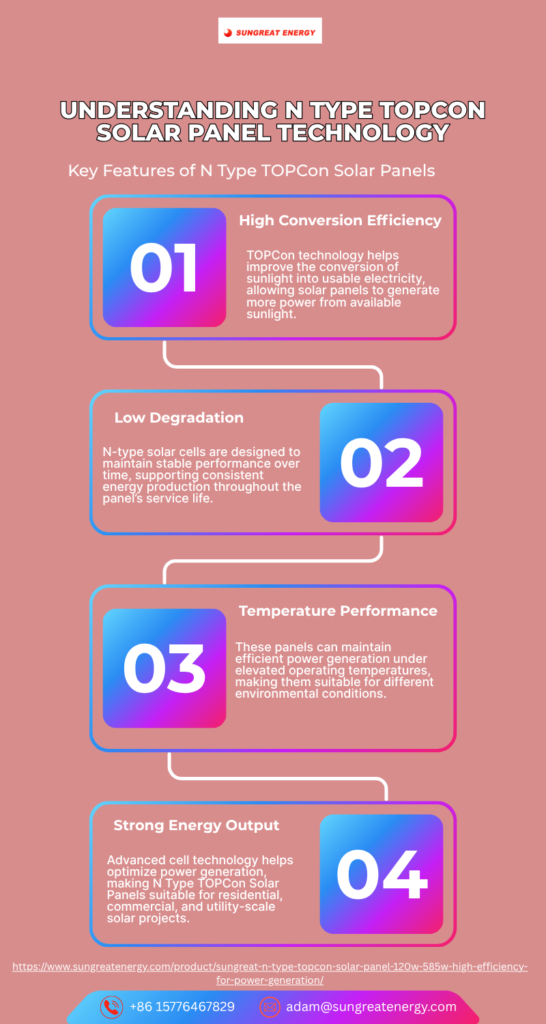
N Type TOPCon Solar Panels represent an advanced approach to photovoltaic power generation, combining modern cell technology with efficient energy conversion. For residential, commercial, and utility-scale applications, this technology can help maximize solar output while supporting long-term system performance. Shenzhen Sungreat Energy Technology Co., Ltd. provides high-efficiency solar panel solutions for diverse renewable energy projects.
Key Benefits of N Type TOPCon Solar Panels
High Efficiency: Advanced TOPCon cell technology helps convert more available sunlight into usable electrical energy.
Lower Degradation: N-type cells can offer stable performance over time, helping maintain energy production throughout the panel’s service life.
Better Temperature Performance: The technology is designed to support reliable power generation under varying operating temperatures.
High Power Output: Efficient cell architecture can deliver strong energy generation from a given installation area.
Long-Term Reliability: Durable construction and advanced photovoltaic technology make these panels suitable for demanding outdoor applications.
By combining efficiency, stability, and modern cell technology, N Type TOPCon Solar Panels provide a practical option for developing efficient and sustainable solar power systems.
Wenzhou, Zhejiang, China, 10.09.2026 – As the global energy landscape shifts toward renewable power, energy storage systems are rapidly becoming an integral part of residential, commercial, and industrial applications. However, battery safety and system reliability remain the primary concerns for system owners and designers alike. Wenzhou Typle New Energy Technology Co., Ltd. is proud to announce the launch of its latest innovation: the advanced Battery Protection Box—a product meticulously engineered to deliver superior safety, performance, and peace of mind for all battery-based energy storage projects.
Chris, spokesperson for Wenzhou Typle New Energy Technology Co., Ltd., commented:
“As more homeowners and businesses invest in renewable energy, safeguarding the battery system is crucial. Our new Battery Protection Box combines the industry’s most robust safety features and quality engineering—ensuring that end-users receive not only power but also protection they can trust. Every feature has a real-world benefit, and we designed this box to anticipate and address every risk scenario.”
The Top Features to Look for in a Battery Protection Box
As you consider energy storage or upgrade your battery enclosure, here are the must-have technical features that any truly secure Battery Protection Box must deliver:
1. Robust Enclosure Design and Material
Chris explains:
“A Battery Protection Box needs to stand up to far more than dust and routine wear—it should be ready for harsh real-world conditions, both indoors and outdoors.”
Industrial-Grade Materials: Look for powder-coated steel, high-impact plastics, or aluminum alloy—ensuring robust, corrosion-resistant protection.
Weatherproofing: An IP rating of at least IP54 is vital for outdoor installations (rain, dust, humidity).
Fire Resistance: Enclosure materials and gaskets must withstand high temperatures and resist ignition—certified to IEC or UL fire safety standards.
2. Integrated Electrical Safety Components
A bare enclosure isn’t enough. The best Battery Protection Box includes these key elements:
DC Fuse Holders and Breakers: Prevent overcurrent or short-circuit events at each battery string.
Surge Protective Devices (SPD): Absorb voltage spikes from lightning, power surges, or grid disturbances.
Pre-wired Busbars: Properly rated for system voltage and current, reducing installation time and risk of wiring errors.
High-Quality Insulation: All internal wiring and mounting hardware must resist arcing and accidental contact.
3. Advanced Thermal Management
Overheating is a major cause of battery failure and even catastrophic fire. The best Battery Protection Boxes feature:
Passive Cooling: Strategic venting/grill design for natural airflow.
Active Cooling Options: Space or pre-wired connections for fans, thermal cutoffs, or temperature sensors.
Thermal Insulation: Layers or materials to contain hotspots and delay heat transmission.
4. Fire and Gas Mitigation Features
If worst-case failure occurs, immediate containment is crucial:
Flameproof or Fire-Retardant Construction: Slows or stops flames from escaping to surrounding spaces.
Pressure Release Vents: Allow hazardous gases to dissipate in a controlled way, preventing enclosure explosions.
Smoke/Gas Detection Ports: For integration with alarms or BMS (Battery Management Systems).
Option for Fire Suppression Modules: Some models allow installation of compact, automatic fire extinguishers.
5. Easy, Secure Maintenance Access
Lockable Doors and Hinges: Prevent unauthorized access.
Quick-Release Panels: Enable fast, safe servicing of batteries or internal wiring.
Clear Labeling: Legible identification of all circuits, terminals, and emergency shut-offs.
Inspection Windows/Lights: View battery status or indicators without needing to open the box.
6. Electrical and Communication Interfaces
Modern energy systems require smart integration:
BMS Interface Ports: Direct wiring for advanced battery management systems and data logging.
Remote Monitoring: Connections for Wi-Fi, Ethernet, or serial communications—enabling remote tracking of voltage, temperature, and state of charge.
Alarm Contacts: For integration with home or plant alarms in case of faults.
7. Compliance and Certification
Your safety may rely on passing code inspections or securing insurance coverage:
Standards Certification: UL, CE, IEC, or local grid/operator codes for enclosures, electrical protection, and fire safety.
Test Reports Available: Don’t just take a seller’s word—ask for certification documentation.
Expandable configurations: Accommodate 2, 4, 8, or 16+ batteries by adding panels
Adjustable cable entries and knockouts -Space for future upgrades or other power electronics
9. Long-Term Durability and Warranty
UV Resistance: For outdoor protection.
Corrosion-Proof Hardware: Stainless steel locks, hinges, and fasteners.
Years of Warranty: Top-tier boxes offer multi-year full coverage and rapid support for any faults.
10. Professional Design from a Reputable Manufacturer
As Chris puts it:
“It’s not just about having a box—it’s about having the right box from an expert in power protection. With our Battery Protection Box, you’re backed by industry-leading support and a proven supply chain.”
Wenzhou Typle New Energy’s Battery Protection Box: Designed for Real-World Excellence
Wenzhou Typle New Energy Technology Co., Ltd.’s new Battery Protection Box is engineered with all these features and more:
Available in both wall-mount and rack-mount versions
Pre-fitted with high-grade DC fuses, SPD, terminal blocks, and monitoring ports
Supported by expert engineers with decades of battery protection experience
From solar farms to residential energy storage systems, Typle’s solution is designed for long service life and certified for the highest safety standards globally.
Why Every Battery Storage Project Needs a Battery Protection Box
Beyond meeting electrical codes and insurance requirements, the Battery Protection Box is essential for:
Protecting both property and people: Prevents battery explosions, fire, and acid/gas venting in the event of faults.
Ensuring backup power is always ready: Prevents premature aging or failure of battery sets.
Reducing costly downtime: By enabling rapid troubleshooting and safe maintenance.
Passes inspections and secures warranties: All regulatory and manufacturer guidelines are met.
Company Overview: Wenzhou Typle New Energy Technology Co., Ltd.
For over a decade, Wenzhou Typle New Energy Technology Co., Ltd. has delivered market-leading electrical protection, switching, and safety solutions for the global renewable energy industry. Our mission is to empower the energy transition by enabling safer, more reliable storage, distribution, and protection wherever electricity is needed.
Media Contact:
Company Name: Wenzhou Typle New Energy Technology Co., Ltd. Contact Name: Chris Contact Phone: +86 180 7206 5770 Address: 5th Floor, No.28 Xinguang Avenue, Xinguang Industrial Zone, Liushi Town, Yueqing, Wenzhou, Zhejiang, China Email: inquiry@typle-electric.com Website: https://www.typle-electric.com/
A quiet revolution is changing how cities, towns, and communities illuminate their streets and public spaces. Spurred by increasing concerns for sustainability, shrinking municipal budgets, and the relentless drive toward a smarter, cleaner future, local governments and property managers are rapidly embracing innovative lighting technologies. Of these, the 20w solar powered parkinglot and street light has emerged as a standout solution—combining advanced LED efficiency with the abundant, free energy of the sun.
Traditionally, outdoor lighting has posed multiple challenges: high operating costs, complicated wiring, vulnerability to outages, and a substantial carbon footprint. However, as urban spaces modernize and communities demand both environmental stewardship and greater public safety, the need for next-generation lighting becomes urgent. The shift to solar-powered systems, especially versatile models like the 20w solar powered parking lot and street light, offers a compelling answer to these needs.
The Changing Face of Urban Lighting
A New Era for Streets and Parking Lots
Municipalities and facility managers have long grappled with the downsides of traditional grid-powered lighting: complex trenching, expensive cabling, frequent outages, and rising electricity bills. In many cases, limited budgets have forced cities to cut back on lighting, potentially compromising safety, visibility, and community vibrancy after dark.
In response, there’s been a decisive shift towards solar-powered lighting—driven by remarkable improvements in photovoltaic and LED technology, falling component costs, and an urgent demand for sustainable infrastructure.
The 20w solar powered parking lot and street light is now at the heart of this revolution. With sufficient output for most neighborhood streets, small lots, walkways, and community centers, this class of lighting is recognized for:
Reliable, off-grid operation
Simple, surface-level installation
Automatic dusk-to-dawn illumination
Clean, renewable energy use
Minimal maintenance requirements
Why 20w Solar Powered Parking Lot and Street Light Solutions?
The Ideal Balance of Power, Efficiency, and Flexibility
While higher wattage solar street lights are available, the 20w model meets a vital sweet spot for many real-world applications. It offers:
Ample Illumination: Delivers appropriate brightness (usually 2400–3200 lumens) for local roads, parking lots, pathways, playgrounds, and security lighting.
Energy Efficiency: Uses premium LEDs that maximize light output while minimizing power draw, making it possible for a compact solar panel and battery to provide reliable nighttime coverage.
Cost-Effectiveness: Lower upfront and installation costs compared to high-powered or grid-connected lights.
Shenzhen Sungreat Energy Technology Co., Ltd. engineers our 20w solar powered parking lot and street lights to ensure maximum luminous efficacy, robust battery life, and weather resistance.
Core Features of Modern 20w Solar Powered Parking Lot and Street Light Systems
1. Integrated Solar Panel and Battery
Monocrystalline or polycrystalline panels paired with lithium or LiFePO4 batteries deliver superior energy conversion and longer operating life.
2. Smart Controls and Sensors
Automatic On/Off: Photocell sensors and timers ensure lights activate only when needed.
Motion Sensing: PIR or radar sensors can boost brightness when pedestrians or vehicles approach, saving even more energy during low-traffic periods.
3. All-in-One Design
Combines lamp, solar panel, battery, and controller in a single housing—simplifying installation and waterproofing.
4. Rugged Weatherproof Construction
Waterproof (IP65/IP66), corrosion-resistant casings designed to withstand rain, wind, dust, and heat.
5. Maintenance-Free Operation
High-quality components mean most systems run for years with little more than occasional cleaning and visual checks.
6. Flexible Mounting
Ideal for new installations or retrofit projects, with pole, wall, or custom bracket options.
Benefits for Communities and Property Owners
1. Significant Cost Savings
With a 20w solar powered parking lot and street light, you eliminate the need for underground wiring and trenching—substantially reducing installation labor and materials. Once installed, solar-powered systems generate no ongoing electricity costs, delivering rapid return-on-investment (ROI).
2. Environmentally Friendly Operations
Each unit runs solely on sunlight. This simple shift from grid to solar eliminates tons of CO₂ emissions annually over the product’s life, helping communities achieve sustainability pledges and green city initiatives.
3. Enhanced Public Safety and Security
Consistent, automatic lighting deters crime, decreases the risk of accidents, improves visibility for motorists and pedestrians, and instills community confidence after sunset.
4. Grid Independence
Because each 20w solar powered parking lot and street light is self-contained, it functions perfectly even during blackouts or in remote, off-grid locations. This resilience is vital in emergencies and disaster recovery scenarios.
5. Scalability and Flexibility
The modular nature of these solutions makes it easy to expand lighting coverage as needs evolve—whether for new subdivisions, pathways, or event spaces.
6. Minimal Maintenance
No wires mean no cable faults. With battery life reaching 5+ years and LEDs rated for 50,000+ hours, these systems require a fraction of the attention of traditional lights.
Where Should 20w Solar Powered Parking Lot and Street Lights Be Used?
Suburban & Residential Streets: Sufficient brightness for local traffic without unnecessary glare.
Parking Lots: Shopping centers, schools, parks, sports grounds, and office lots benefit from 24/7 illumination and improved safety.
Pedestrian Pathways & Walkways: Safer, well-lit routes for joggers or late-night commuters.
Community Parks & Playgrounds: Nighttime usability and reduced vandalism.
Transit Stops & Small Stations: Greater visibility and security for travelers.
Rural Roads: Practical solution for areas lacking electrical infrastructure.
Choosing the Right 20w Solar Powered Parking Lot and Street Light
Key Features to Seek
High-Efficiency Solar Panels: For rapid charging even in partially shaded conditions.
Long-Life Batteries: Prefer LiFePO4, which endures more charging cycles.
Quality LEDs: High lumens-per-watt, true color rendering, and low decay rates.
Smart Electronics: Protection circuits (overcharge/discharge/short) and energy management software.
Color Temperature: Warm white for hospitality areas, cool white for streets.
Mounting Heights and Angles: Adapt to diverse environments.
Sensor Integration: For adaptive dimming or remote control.
Aesthetic Choices: Sleek, modern housings that blend with urban designs.
The Sungreat Energy Approach
Our 20w solar powered parking lot and street light series is engineered to deliver:
Consistent Peak Performance: Regardless of season or climate zone.
Simplified Installation: No specialized tools, no deep technical expertise required.
Long-Term Savings: Proven durability for decade-long operational savings.
Full Compliance: With ISO, CE, TUV, and local standards.
Project Support From Start to Finish
Sungreat Energy partners with communities, city planners, and facility managers to provide:
Site Assessment and Design: Tailor every project for optimal layout, coverage, and cost.
Installation Guidance: Clear manuals, remote support, and optional on-site training.
After-Sales Service: Spare parts, remote troubleshooting, and warranty assistance.
Steps to Upgrade Your Community Lighting
Evaluate Current Lighting: Determine coverage, gaps, and areas for improvement.
Define Goals: Energy savings, safety, environmental impact, aesthetics, or smart features.
Request Proposals/Quotations: Invite technical and financial submissions from leading suppliers.
Assess Product Quality: Review specifications, certifications, and real-world installations.
Pilot Installation: Field-test a small batch to confirm performance before full-scale rollout.
Roll Out Grid-Free Lighting: Implement in phases for minimal disruption.
Monitor Results: Use built-in analytics (where available) to gauge savings and reliability.
Real-World Impact: Sungreat Energy Success Stories
Suburban Towns: Saw energy bills drop by over 60% in the first year after switching to 20w solar powered parking lot and street lights.
Coastal Villages: Improved visitor safety and night-time tourism by upgrading to corrosion-resistant solar lighting, withstanding salt and humidity.
Mixed-Use Campuses: Achieved compliance with green building standards while boosting resident and visitor satisfaction.
The future of community lighting is here—and it’s both powerful and sustainable. Upgrading with 20w solar powered parking lot and street lightsolutions empowers towns, campuses, and businesses to illuminate public spaces with minimal environmental impact, superior reliability, and remarkable cost savings.
Common Questions: FAQ for 20w Solar Powered Parking Lot and Street Light
1. How long does a 20w solar powered parking lot and street light run at night?
Most models provide 8–12 hours of illumination per night, with some offering extended autonomy (2–3 nights) in case of several cloudy days, thanks to battery storage.
2. How bright is a 20w solar powered parking lot and street light?
Typically produces 2400–3200 lumens—adequate for urban side streets, parking lots, and pathways.
3. Will a 20w solar powered street light work in winter or cloudy climates?
Yes. Modern units use high-efficiency panels and batteries with reserve capacity to ensure operation even in less-sunny conditions.
4. How do I install a solar powered street light?
Simple surface-mount or pole-mount installations can be completed with basic tools – no cabling or trenching needed.
5. Are these lights vandal- or theft-resistant?
Premium models feature rugged, tamper-resistant housings and secure mounting hardware.
6. Do they require ongoing maintenance?
Minimal; keep panels clean and check for debris or damage seasonally. Replace batteries every 5–7 years depending on usage.
7. Can I integrate these lights into a smart city platform?
Yes. Sungreat Energy offers optional remote control, monitoring, and integration with broader smart city networks.
8. What is the warranty policy?
Most systems offer at least a 3-year warranty covering major components and labor.
9. What about dark sky compliance?
Directional optics and shielding minimize light pollution, supporting residents’ health and local wildlife.
10. How quickly is ROI achieved?
Most projects see payback within 2–4 years compared to conventional wired lighting installations.
A night guard is an excellent investment in your oral health, especially if you grind or clench your teeth while sleeping. It helps protect your teeth from excessive wear, reduces pressure on your jaw, and may even minimize morning headaches caused by teeth grinding. However, simply wearing a night guard isn’t enough. Proper cleaning and maintenance are essential to keep it free from bacteria, prevent unpleasant odors, and extend its lifespan.
If you’ve received a custom appliance from a dentist in Vancouver, following the right care routine will help ensure it continues to fit comfortably and protect your smile. Here are ten practical tips that can help you keep your night guard clean, safe, and in excellent condition.
Why Is Night Guard Care Important?
Your night guard spends several hours inside your mouth every night. During that time, it comes into contact with saliva, bacteria, and plaque. Without proper cleaning, these substances can build up, leading to bad odors, discoloration, and even oral health concerns.
Good maintenance also helps preserve the fit of your appliance and reduces the likelihood of needing an early replacement.
1. Rinse Your Night Guard After Every Use
As soon as you remove your night guard each morning, rinse it under cool or lukewarm water. This helps remove saliva and loose debris before it dries on the surface.
Avoid using hot water because it may warp the material and affect the fit.
2. Clean It Daily with a Soft Toothbrush
Use a soft-bristled toothbrush to gently clean all surfaces of your night guard. Brush carefully without using excessive force that could scratch the appliance.
Many dentists recommend avoiding abrasive toothpaste because it may leave tiny scratches where bacteria can collect.
3. Use a Recommended Cleaning Solution
Occasionally soaking your night guard in a cleaning solution recommended by your dentist helps remove bacteria and stains that daily brushing may miss.
Always follow the instructions provided for the cleaning product and rinse the appliance thoroughly before wearing it again.
4. Allow It to Dry Completely
Moisture encourages bacterial growth. After cleaning your night guard, allow it to air dry completely before placing it in its storage case.
This simple step helps keep your appliance cleaner between uses.
5. Store It in a Protective Case
Always keep your night guard in its ventilated storage case when it is not being worn.
A storage case helps:
Protect the appliance from damage.
Reduce exposure to dirt and bacteria.
Prevent accidental loss.
Keep pets from chewing on it.
6. Keep It Away from Heat
High temperatures can distort the shape of your night guard.
Avoid:
Hot water.
Dishwashers.
Microwaves.
Leaving it inside a hot vehicle.
Proper storage helps maintain a comfortable and accurate fit.
7. Never Share Your Night Guard
Night guards are custom-made to fit one person’s teeth. Sharing them is unhygienic and may expose others to bacteria while also preventing the appliance from fitting properly.
8. Inspect Your Night Guard Regularly
Take a close look at your night guard every few weeks.
Watch for:
Cracks.
Rough edges.
Holes.
Discoloration.
Changes in fit.
If you notice any of these problems, schedule a dental appointment.
9. Maintain Good Oral Hygiene
Cleaning your teeth before wearing your night guard is just as important as cleaning the appliance itself. Brushing and flossing before bed helps reduce plaque and bacteria that could become trapped between your teeth and the guard.
Maintaining consistent dental care in Vancouver supports both your oral health and the condition of your night guard.
10. Bring Your Night Guard to Dental Checkups
Your dentist should examine your night guard during routine dental visits. Regular inspections help identify signs of wear and confirm that the appliance still fits correctly.
If you’re using a custom Night Guard in Vancouver, these routine evaluations help ensure it continues providing effective protection against teeth grinding.
When Should You Replace Your Night Guard?
Even well-maintained night guards eventually wear out. Depending on the severity of your teeth grinding and how well you care for the appliance, it may need replacement after several years.
You should contact your dentist if your night guard:
Feels loose.
Causes discomfort.
Develops cracks or holes.
Shows significant wear.
No longer fits properly.
When Should You See a Dentist?
If your night guard becomes uncomfortable, develops an odor that doesn’t improve with cleaning, or no longer fits properly, schedule a dental evaluation. A poorly fitting appliance may not protect your teeth effectively and could contribute to jaw discomfort.
Visiting a dentist near you also allows your appliance to be professionally examined and adjusted if necessary.
Conclusion
Proper cleaning and maintenance help your night guard stay comfortable, hygienic, and effective for years. Simple daily habits such as rinsing, brushing, proper storage, and regular dental checkups can significantly extend its lifespan while protecting your oral health. If you have questions about caring for your night guard or believe it may need adjustment or replacement, the experienced team at City Square Dental Centre is here to help. Request an Appointment to keep your smile protected and your night guard performing at its best.
Frequently Asked Questions
How often should I clean my night guard?
You should rinse your night guard every morning after removing it and clean it daily using a soft toothbrush. Regular cleaning helps remove bacteria, plaque, and saliva while preventing unpleasant odors and buildup.
Can I use toothpaste to clean my night guard?
Many toothpastes contain abrasive ingredients that may scratch the surface of the appliance. A soft toothbrush with water or a dentist-recommended cleaning solution is generally the safer option.
How often should I soak my night guard?
Most patients benefit from soaking their night guard periodically using a cleaning solution recommended by their dentist. The exact frequency depends on how often the appliance is worn and your dentist’s instructions.
Why does my night guard smell bad?
Odors usually develop when bacteria and plaque accumulate on the appliance. Daily cleaning, allowing it to dry completely, and storing it in a ventilated case can help prevent unpleasant smells.
How long does a custom night guard last?
With proper care, many custom night guards last several years. The lifespan depends on the severity of teeth grinding, how often the appliance is worn, and how well it is maintained.
Can I wear a cracked night guard?
No. A cracked night guard may not protect your teeth properly and could become uncomfortable. If you notice damage, schedule a dental appointment to have it evaluated and replaced if necessary.
Should I bring my night guard to dental appointments?
Yes. Bringing your night guard to routine checkups allows your dentist to inspect it for wear, confirm it still fits correctly, and recommend adjustments or replacement if needed.
It’s common for young children to accidentally swallow toothpaste while learning to brush their teeth. Since many toothpastes have pleasant flavors, children may be tempted to swallow them instead of spitting them out. In most cases, swallowing a small amount of toothpaste during brushing is not a medical emergency. However, swallowing a large amount may cause stomach discomfort and requires closer attention.
If you’re unsure about what to do after your child swallows toothpaste, staying calm is the first step. Speaking with a dentist in Edmonton can help you understand whether the situation requires professional care and how to prevent it from happening again. Knowing the difference between a small accidental swallow and a larger amount can help parents respond appropriately.
Is Swallowing Toothpaste Dangerous?
Most children’s toothpastes contain fluoride, which helps strengthen tooth enamel and prevent cavities. While fluoride is safe when used as directed, swallowing excessive amounts of toothpaste can sometimes cause mild stomach upset.
In most situations, swallowing the small amount left after brushing is not harmful. Problems are more likely if a child eats toothpaste directly from the tube or repeatedly swallows large amounts over time.
What Should You Do Right Away?
If your child accidentally swallows toothpaste, follow these simple steps:
Stay calm and avoid panicking.
Find out approximately how much toothpaste was swallowed.
Offer your child a glass of water to drink.
Avoid giving additional toothpaste until the next brushing session.
Monitor your child for any unusual symptoms.
If only a pea-sized amount or less was swallowed during brushing, no treatment is usually necessary.
What Symptoms Should You Watch For?
Swallowing a larger amount of fluoride toothpaste may cause temporary digestive discomfort.
Possible symptoms include:
Upset stomach.
Nausea.
Vomiting.
Abdominal pain.
Diarrhea.
These symptoms are usually mild but should be monitored closely.
When Should You Seek Medical Advice?
You should contact your healthcare provider or your local poison information service if:
Your child swallowed a large amount of toothpaste.
Your child develops persistent vomiting.
Severe stomach pain occurs.
Your child appears unusually sleepy or unwell.
You are unsure how much toothpaste was swallowed.
Seeking advice promptly can help determine whether further evaluation is necessary.
How Much Toothpaste Should Children Use?
Using the correct amount of toothpaste helps reduce the chance of swallowing too much fluoride.
Children Under 3 Years Old
A smear or rice-sized amount of fluoride toothpaste is generally recommended.
Children Ages 3 to 6
A pea-sized amount is usually appropriate.
Children should also be encouraged to spit out toothpaste instead of swallowing it after brushing.
Tips to Prevent Children from Swallowing Toothpaste
Teaching good brushing habits early can make a big difference.
Supervise brushing until your child can brush independently.
Use only the recommended amount of toothpaste.
Teach your child to spit instead of swallow.
Store toothpaste out of children’s reach.
Avoid letting children play with toothpaste.
Choose age-appropriate fluoride toothpaste.
Can Swallowing Toothpaste Affect Teeth?
Occasionally swallowing small amounts during brushing is not likely to affect developing teeth. However, regularly swallowing excessive fluoride over a long period during early childhood may contribute to a condition called dental fluorosis, which can cause mild white spots or streaks on permanent teeth.
Using the proper amount of toothpaste greatly reduces this risk.
How to Make Brushing Easier for Young Children
Many children swallow toothpaste simply because they are still learning proper brushing techniques.
You can help by:
Brushing together as a family.
Demonstrating how to spit into the sink.
Using a timer to make brushing fun.
Offering praise for good brushing habits.
Making brushing part of a daily routine.
Consistent dental care in Edmonton combined with healthy home habits helps children build lifelong oral hygiene skills.
When Should You Visit a Dentist?
If your child frequently swallows toothpaste, refuses to spit after brushing, or you have concerns about fluoride use, it’s a good idea to schedule a dental visit. Your dentist can recommend the right toothpaste, brushing techniques, and fluoride amount based on your child’s age.
If the incident happens outside of regular office hours and you have ongoing concerns, a Weekend dentist in Edmonton may be able to evaluate your child and provide guidance if a dental assessment is needed.
Regular checkups with a dentist near you also help monitor your child’s oral development and reinforce healthy brushing habits.
Conclusion
Accidentally swallowing a small amount of toothpaste is a common part of learning to brush and is usually not a cause for concern. Using the correct amount of toothpaste, supervising brushing, and teaching children to spit can help prevent future incidents. If you have questions about your child’s oral health or brushing habits, the team at Manchester Dental is here to help. Request an Appointment to receive personalized guidance and support for your child’s healthy smile.
Frequently Asked Questions
Is it normal for children to swallow toothpaste?
Yes. Many young children accidentally swallow small amounts of toothpaste while learning to brush. As they develop better brushing skills, they usually learn to spit out the toothpaste instead of swallowing it.
What happens if my child swallows a pea-sized amount of toothpaste?
Swallowing a pea-sized amount during brushing is generally not harmful. Most children will not experience any symptoms, although offering a drink of water afterward is a good idea.
How much toothpaste should a toddler use?
Children younger than three years old should use only a rice-sized smear of fluoride toothpaste. This amount provides cavity protection while reducing the chance of swallowing too much fluoride.
Should I make my child vomit after swallowing toothpaste?
No. Do not try to make your child vomit. Instead, offer water and monitor them for symptoms. If a large amount was swallowed or concerning symptoms develop, seek medical advice promptly.
Can swallowing toothpaste cause stomach pain?
Yes. Swallowing a large amount of fluoride toothpaste may cause temporary nausea, stomach discomfort, vomiting, or diarrhea. These symptoms are usually mild but should be evaluated if they become severe or persistent.
How can I teach my child to stop swallowing toothpaste?
Supervise brushing, demonstrate how to spit, use only the recommended amount of toothpaste, and encourage practice every day. Positive reinforcement often helps children develop proper brushing habits more quickly.
When should I contact a dentist after my child swallows toothpaste?
If your child repeatedly swallows toothpaste, has difficulty learning to spit, or you have concerns about fluoride exposure, schedule a dental appointment. Your dentist can provide age-appropriate advice and answer any questions about safe brushing habits.
Keeping your Invisalign aligners clean is an important part of your orthodontic treatment. Since the aligners are worn for most of the day, they can accumulate bacteria, plaque, and food particles if not cleaned properly. Poor maintenance may lead to unpleasant odors, discoloration, and an increased risk of cavities or gum problems.
If you’re receiving treatment from a dentist in Sherwood Park, you’ll likely receive instructions on how to care for both your aligners and your teeth throughout the process. Following these recommendations helps keep your aligners clear, comfortable, and effective while supporting your overall oral health.
Why Is It Important to Clean Invisalign Aligners?
Invisalign aligners fit closely against your teeth for 20 to 22 hours each day. Because of this, bacteria and plaque can become trapped between your teeth and the aligners if they are not cleaned regularly.
Cleaning your aligners every day helps:
Reduce bacteria buildup.
Prevent unpleasant odors.
Keep the aligners clear and nearly invisible.
Lower the risk of cavities and gum disease.
Improve overall comfort during treatment.
How to Clean Invisalign Aligners Every Day
Rinse Them Whenever You Remove Them
Each time you remove your aligners, rinse them under lukewarm water. This helps wash away saliva and prevents buildup from drying on the plastic.
Avoid using hot water because it may warp the aligners and affect their fit.
Brush Your Aligners Gently
Use a soft-bristled toothbrush and lukewarm water to gently clean the inside and outside of the aligners.
Brush carefully without applying excessive pressure to avoid scratching the plastic.
Use Recommended Cleaning Products
Your dentist may recommend Invisalign cleaning crystals or other aligner-safe cleaning products. These solutions help remove bacteria and stains while protecting the material.
What Should You Avoid When Cleaning Invisalign?
Some cleaning methods can damage your aligners or reduce their clarity.
Avoid using:
Hot or boiling water.
Bleach or harsh household cleaners.
Abrasive toothpaste.
Colored mouthwash that may stain the aligners.
Rough brushes that can scratch the plastic.
Should You Brush Your Teeth Before Wearing Invisalign?
Yes. Always brush and floss your teeth before putting your aligners back in. Placing aligners over food particles or plaque allows bacteria to remain against your teeth for extended periods, increasing the risk of cavities and gum irritation.
If brushing is not possible immediately after eating, rinse your mouth with water until you can brush properly.
How Should You Store Invisalign Aligners?
Whenever you remove your aligners, place them in their protective storage case.
This helps:
Prevent accidental damage.
Reduce exposure to bacteria.
Keep pets from chewing on them.
Lower the chance of losing them.
Wrapping aligners in a napkin during meals often leads to them being accidentally thrown away.
Can You Eat or Drink While Wearing Invisalign?
You should remove your aligners before eating any food. Drinks other than plain water should also be avoided while wearing them.
Coffee, tea, soft drinks, sports drinks, and colored beverages can stain the aligners and may increase the risk of tooth decay if sugars become trapped beneath them.
How Often Should Invisalign Aligners Be Cleaned?
Cleaning your aligners should become part of your daily routine.
Rinse them whenever they are removed.
Brush them at least twice each day.
Clean them thoroughly using a recommended cleaning solution as directed by your dentist.
Consistent cleaning helps maintain both the appearance of the aligners and your oral health throughout treatment.
Signs Your Aligners Need Better Care
If your aligners are not being cleaned properly, you may notice:
Cloudy appearance.
Unpleasant odor.
Visible plaque buildup.
Yellow discoloration.
Bad breath.
Improving your cleaning routine usually helps prevent these problems.
Additional Tips for Invisalign Success
Wear your aligners for 20 to 22 hours every day.
Follow your aligner change schedule.
Attend all scheduled dental appointments.
Drink plenty of water throughout the day.
Maintain regular brushing and flossing habits.
If you’re receiving Invisalign in Sherwood Park, following these simple habits helps keep your treatment progressing as planned while protecting your smile.
When Should You Contact Your Dentist?
Contact your dental office if your aligners become cracked, no longer fit properly, develop persistent discoloration despite cleaning, or if you lose an aligner. Addressing these issues promptly helps prevent unnecessary delays in your treatment.
If you have questions about caring for your aligners or your orthodontic progress, visiting a dentist near you allows you to receive personalized guidance and keep your treatment on track.
Conclusion
Keeping your Invisalign aligners clean is essential for maintaining their appearance, preventing bacteria buildup, and supporting successful orthodontic treatment. Daily cleaning, proper storage, and good oral hygiene all play an important role in achieving the best possible results. If you need guidance on caring for your aligners or have questions about your treatment, the experienced team at Salisbury Dental is here to help. Request an Appointment to receive personalized advice and keep your smile moving in the right direction.
Frequently Asked Questions
How often should I clean my Invisalign aligners?
You should rinse your aligners every time you remove them and gently brush them at least twice a day. Using an aligner cleaning solution as recommended by your dentist can also help remove bacteria and keep them clear.
Can I brush my Invisalign aligners with toothpaste?
Many toothpastes contain abrasive ingredients that may scratch the aligners and make them appear cloudy. A soft toothbrush with lukewarm water or a cleaning product recommended by your dentist is usually the better option.
Can I drink coffee while wearing Invisalign?
No. Coffee and other beverages besides plain water should be consumed after removing your aligners. Hot drinks may warp the plastic, while dark-colored beverages can stain the aligners and increase the risk of tooth decay.
What happens if I don’t clean my Invisalign aligners?
Poor cleaning habits can allow bacteria, plaque, and food particles to build up on the aligners. This may lead to unpleasant odors, discoloration, bad breath, cavities, and gum irritation during treatment.
Can I soak Invisalign aligners overnight?
Yes, if you use a cleaning solution recommended for clear aligners. Soaking helps remove bacteria and stains, but always follow the manufacturer’s instructions and rinse the aligners before wearing them again.
Why do my Invisalign aligners look cloudy?
Cloudiness is usually caused by plaque buildup, mineral deposits from saliva, or improper cleaning. Regular brushing, rinsing, and using appropriate cleaning products can help keep your aligners clear throughout treatment.
How should I store my Invisalign aligners when eating?
Always place your aligners in their protective storage case whenever you remove them. This helps prevent damage, contamination, and accidental loss while making it easier to keep track of them during meals.
Black spots on your teeth can be concerning, especially if they appear suddenly or become more noticeable over time. While some black spots are harmless surface stains, others may be an early sign of tooth decay or another dental condition that requires professional care. Understanding the cause is the first step toward choosing the safest and most effective treatment.
If you’ve noticed dark spots on one or more teeth, scheduling an examination at a dental clinic in Red Deer can help determine whether the discoloration is a simple stain or a problem that needs treatment. Early diagnosis often prevents minor concerns from developing into more serious dental issues.
What Causes Black Spots on Teeth?
Black spots can develop for several reasons. Some affect only the outer surface of the tooth, while others involve the tooth’s inner structure.
1. Surface Stains
One of the most common causes is staining from foods, drinks, or tobacco products. Coffee, tea, red wine, berries, and smoking can gradually darken the enamel, creating black or dark brown spots.
2. Tooth Decay
A cavity may first appear as a small brown or black spot. As decay progresses, the spot can become darker and may eventually lead to pain or sensitivity if left untreated.
3. Tartar Buildup
Plaque that is not removed through brushing and flossing can harden into tartar. Over time, tartar may become dark or black, particularly near the gumline.
4. Dental Injuries
A tooth that has experienced trauma may darken if the inner tissue has been affected. This type of discoloration usually involves the entire tooth rather than a small spot.
5. Certain Medications or Dental Materials
Some medications and older metal dental fillings may contribute to dark discoloration over time. Your dentist can determine whether the spot is related to a previous dental restoration.
Can Black Spots Be Removed at Home?
It depends on the cause. Surface stains may improve with good oral hygiene, but black spots caused by cavities, tartar, or dental injuries cannot be safely removed at home.
Avoid attempting to scrape or scrub the spots aggressively, as this may damage the enamel and make the problem worse.
Safe Ways to Remove Black Spots on Teeth
Professional Dental Cleaning
If black spots are caused by plaque or tartar buildup, a professional dental cleaning can often remove the deposits safely without damaging your teeth.
Polishing
After cleaning, your dental hygienist may polish the teeth to remove surface stains and improve their appearance.
Dental Fillings
If a black spot is caused by tooth decay, your dentist may remove the damaged portion of the tooth and restore it with a tooth-colored filling.
Professional Teeth Whitening
For discoloration caused by surface stains, professional whitening may improve the appearance of your smile. However, whitening treatments will not remove decay or tartar.
Dental Crowns or Veneers
If discoloration is severe or caused by structural damage, your dentist may recommend a crown or veneer to restore both the appearance and function of the tooth.
Home Care Tips to Help Prevent Black Spots
Good oral hygiene can help reduce the risk of stains and tooth decay.
Brush twice daily using fluoride toothpaste.
Floss once every day.
Rinse your mouth with water after drinking coffee, tea, or soft drinks.
Limit sugary foods and beverages.
Avoid tobacco products.
Replace your toothbrush every three to four months.
Foods and Drinks That May Cause Staining
Some foods and beverages are more likely to stain your teeth over time.
Coffee.
Black tea.
Red wine.
Dark-colored soft drinks.
Soy sauce.
Berries.
Balsamic vinegar.
Drinking water after consuming these items can help reduce staining.
When Should You See a Dentist?
You should schedule a dental examination if:
A black spot does not brush away.
The spot becomes larger over time.
You experience tooth pain or sensitivity.
Your gums become swollen or bleed.
The tooth changes color after an injury.
Prompt treatment often prevents more extensive dental procedures and helps preserve your natural tooth.
Can Black Spots Always Be Prevented?
Not every black spot can be prevented, especially if it results from an injury or certain medical conditions. However, maintaining consistent oral hygiene, eating a balanced diet, limiting stain-causing foods, and attending routine dental checkups greatly reduce your risk.
Routine dental care in Red Deer also allows dental professionals to identify early signs of decay or staining before they become more difficult to treat.
Why Professional Evaluation Is Important
Although many black spots are harmless stains, others may indicate cavities or underlying dental problems. Because it is difficult to determine the exact cause at home, a professional examination is the safest way to receive an accurate diagnosis and appropriate treatment.
If you’re unsure about changes in the appearance of your teeth, visiting adentist near you allows potential concerns to be addressed before they become more serious.
Conclusion
Black spots on your teeth may be caused by staining, tartar buildup, tooth decay, or other dental conditions. The right treatment depends on the underlying cause, which is why professional evaluation is important. Maintaining good oral hygiene and attending routine dental visits can help keep your smile healthy and bright. If you’re concerned about black spots on your teeth, the experienced team at Delta Dental is here to help. Request an Appointment to receive a personalized evaluation and appropriate treatment for your smile.
Frequently Asked Questions
Are black spots on teeth always cavities?
No. Black spots can be caused by surface stains, tartar buildup, older dental restorations, or tooth decay. Because different conditions can appear similar, a dental examination is the best way to determine the exact cause.
Can brushing remove black spots on teeth?
Brushing may remove some surface stains if they are mild. However, black spots caused by tartar, cavities, or deeper discoloration usually require professional dental treatment for safe and effective removal.
Is it safe to remove black spots at home?
No. Avoid scraping or using abrasive products to remove black spots yourself, as this may damage your enamel. If a spot does not disappear with normal brushing, schedule a dental examination instead.
Can teeth whitening remove black spots?
Professional whitening can improve stains on the tooth surface but will not remove cavities, tartar, or internal discoloration. Your dentist will determine whether whitening is appropriate based on the cause of the spot.
When should I worry about a black spot on my tooth?
You should see a dentist if the spot becomes larger, causes pain or sensitivity, does not brush away, or appears after a dental injury. Early treatment often prevents more serious dental problems.
How can I prevent black stains on my teeth?
Brush and floss daily, limit coffee, tea, and tobacco use, rinse your mouth with water after consuming stain-causing foods or drinks, and attend regular professional dental cleanings to help reduce staining.
How often should I have my teeth professionally cleaned?
Most people benefit from professional dental cleanings every six months. However, your dentist may recommend more frequent visits depending on your oral health, plaque buildup, or risk of gum disease.
It was the kind of meeting that usually ends with polite conclusions and delayed action plans.
But this one ended differently.
The CFO slid a printed report across the table and said something that changed the tone instantly.
“We are spending millions on automation, but I still cannot trace where the ROI is actually coming from.”
Silence followed.
This was a large enterprise with strong digital infrastructure, multiple ERPs, and years of transformation initiatives. Yet the return on investment felt blurry.
That was the moment AI Agent development company led thinking entered the conversation, and the story of measurable ROI transformation truly began.
I was part of that engagement, working closely with a consulting and engineering team from Yudiz Solutions, and what unfolded over the next months was less about software deployment and more about redesigning how work itself flows inside an enterprise.
The hidden problem behind “we are already automated”
On paper, the organization looked advanced.
They had:
9 enterprise systems across departments
27 automated workflows
14 reporting dashboards
3 cloud based integration layers
Hundreds of RPA bots already deployed
But something was still not adding up.
Operational costs were still rising by 12 to 18 percent year over year.
One operations director put it bluntly:
“We automated tasks, but not the process thinking behind them.”
And that was the real issue.
Automation existed in fragments, not as a unified intelligence layer.
Where ROI was leaking silently
A breakdown revealed:
34 percent time spent on system reconciliation
22 percent effort lost in manual exception handling
18 percent duplication of automated workflows
16 percent delay in cross system communication
10 percent untracked operational overhead
In simple terms, automation existed, but intelligence did not.
The shift from automation to AI agent driven operations
The turning point came during a workshop where the consulting team from Yudiz Solutions asked a fundamental question.
“What if your workflows were not automated steps, but intelligent agents coordinating outcomes?”
That reframed everything.
Instead of:
Process → Automation Tool → Output
The new model became:
Agent A → Agent B → Agent C → Collaborative Decision → Execution
One enterprise architect described it best:
“We were automating tasks. Now we are simulating teams.”
That is where AI Agent development started becoming a measurable business strategy rather than a technology upgrade.
Building the enterprise AI agent ecosystem
The transformation was structured into multiple agent layers that worked together like a digital organization.
1. Process intelligence agents
These agents analyzed existing workflows and identified inefficiencies such as:
redundant approvals
delayed escalations
unnecessary manual interventions
One discovery alone saved 17 percent processing time in procurement workflows.
2. Decision automation agents
These agents handled rule based and semi dynamic decisions.
Example:
Approving vendor invoices under threshold
Routing support tickets
Prioritizing production orders
A finance manager said:
“It feels like decisions are happening before we even open the dashboard.”
3. Cross system coordination agents
This was where real ROI started becoming visible.
These agents connected:
ERP systems
CRM platforms
supply chain tools
finance modules
analytics dashboards
Instead of APIs acting as passive connectors, agents actively coordinated data flow.
This reduced human intervention in exception handling by nearly 46 percent.
5. Continuous optimization agents
These agents constantly monitored performance and improved workflows over time.
A senior analyst said:
“We no longer optimize processes manually. The system learns and optimizes itself.”
ROI before vs after AI agent transformation
Once the system stabilized, the financial impact became measurable.
Metric
Before
After AI Agents
Operational cost reduction
Baseline
28 percent decrease
Process cycle time
High
52 percent faster
Manual intervention rate
60 percent
25 percent
System downtime impact
Frequent delays
Reduced by 41 percent
Workflow duplication
High
Near eliminated
ROI visibility
Unclear
Fully traceable per process
One CFO said during review:
“For the first time, I can connect every rupee spent to a process outcome.”
The moment ROI became visible in real time
One of the most powerful demonstrations came from the finance automation module.
Earlier:
Invoice processing took 6 to 8 days
5 departments involved in approval chain
Frequent delays due to mismatched data
After AI agents:
Invoice processing reduced to under 36 hours
Approval chain reduced to dynamic routing
Error detection became real time
A finance controller said:
“It feels like the system is paying attention to us instead of us chasing the system.”
That shift directly improved working capital efficiency.
Why traditional automation failed to deliver ROI clarity
Before AI agents, enterprises relied heavily on:
RPA bots
workflow engines
integration platforms
static dashboards
But these systems had limitations:
Key gaps
They executed tasks but did not understand context
They could not collaborate across workflows
They lacked adaptive decision making
They required constant human supervision
One CIO summarized it perfectly:
“We built tools that work. We never built systems that think together.”
How AI agents changed ROI measurement itself
This was one of the most surprising outcomes.
Instead of measuring ROI at a macro level, enterprises started measuring it per agent.
Example:
Agent Type
ROI Contribution
Procurement agent
14 percent cost savings
Finance reconciliation agent
11 percent efficiency gain
Customer support agent
19 percent reduction in resolution time
Supply chain agent
22 percent delay reduction
Suddenly, ROI was no longer abstract.
It became modular, trackable, and scalable.
Inside the implementation approach that made ROI possible
The success was not accidental. It was structured.
The engineering and consulting approach led by Yudiz Solutions followed a clear methodology:
1. Process discovery phase
Mapping every enterprise workflow in detail, identifying friction points.
2. Agent design phase
Breaking workflows into intelligent agent roles instead of static automation scripts.
3. Agile build and integration phase
Iterative development cycles with real enterprise feedback loops.
4. Deployment and monitoring phase
Continuous tracking of performance metrics tied directly to ROI indicators.
5. Optimization phase
AI driven improvements based on usage data.
One enterprise head described it as:
“They didn’t just implement AI. They re-engineered how we measure success.”
Industry wide impact of AI agent driven ROI models
Once results were proven, similar models were adopted across:
Banking and financial services
Healthcare operations
Manufacturing supply chains
Retail inventory systems
Logistics and transportation networks
EdTech administration systems
HR and recruitment pipelines
Gaming backend operations
Social media moderation systems
Wherever workflows were fragmented, ROI gaps were high. AI agents closed them.
Measurable enterprise outcomes
After full rollout, the enterprise reported:
31 percent overall operational cost reduction
2.6 times faster process execution
47 percent improvement in workflow accuracy
39 percent reduction in manual workload
54 percent improvement in process visibility
3.2 times faster ROI realization compared to traditional automation
But one metric stood out more than others:
Decision-to-value time reduced by 61 percent.
That meant value creation started happening faster after any operational change.
A conversation that defined the transformation
During the final board presentation, the CFO asked a simple question:
“So what changed fundamentally?”
The answer from the implementation lead was even simpler:
“You stopped automating work. You started automating outcomes.”
That line stayed in the room longer than the presentation itself.
The human impact behind ROI numbers
Beyond metrics, something else changed quietly.
Employees stopped dealing with repetitive system issues.
Teams spent less time fixing errors and more time analyzing outcomes.
One operations manager said:
“For the first time, I am not reacting to problems. I am understanding them early.”
That shift improved morale as much as efficiency.
Final reflection: ROI in the age of AI agents
Enterprises are no longer asking whether automation works.
They are asking whether automation understands context.
AI Agent development company driven systems are changing the definition of ROI itself.
It is no longer just about cost reduction.
It is about:
speed of decision making
clarity of process intelligence
reduction in operational friction
continuous self improvement
And when implemented with structured engineering depth, like the approach followed by Yudiz Solutions, ROI stops being a report at the end of the quarter.
It becomes a living metric that improves every day.
Because in the end, the real return on investment is not just saving money.
It is building an enterprise that gets smarter while it works.
Introduction: The Day the Metaverse Buzz Stopped Impressing Executives
Back in 2022, it felt like every boardroom conversation eventually arrived at the same topic.
The Metaverse.
Consultants were presenting futuristic visions.
Technology vendors were showcasing virtual worlds.
Industry analysts were predicting trillion-dollar opportunities.
And brands everywhere feared being left behind.
For a while, executives approved exploratory budgets simply because competitors were doing the same.
Virtual stores were launched.
Digital experiences were tested.
Experimental projects were funded.
Yet after the initial excitement faded, many leadership teams began asking a much harder question.
“Where is the return on investment?”
One global retail and consumer products company found itself facing exactly that challenge.
After investing heavily in various digital initiatives, the organization struggled to identify measurable business outcomes from several experimental Metaverse-related projects.
Customer engagement remained unchanged.
Conversions showed minimal improvement.
Operational efficiency gains were difficult to quantify.
The company wasn’t alone.
Across industries, organizations began realizing that immersive technology itself wasn’t the problem.
The problem was building experiences for headlines instead of business outcomes.
That’s when the company decided to take a different approach.
Instead of chasing Metaverse trends, they partnered with Yudiz Solutions to explore practical applications of AR Development, VR Development, and Mixed Reality technologies that could directly impact customer engagement, employee productivity, and revenue growth.
The results changed how leadership viewed immersive technology forever.
The Problem with Most Metaverse Initiatives
Why Many Brands Failed to Generate Meaningful Results
The early wave of Metaverse adoption was driven largely by fear of missing out.
Brands rushed to launch virtual experiences without clearly defining business objectives.
Many organizations asked:
How do we enter the Metaverse?
How do we create virtual experiences?
How do we build digital environments?
Few asked:
What customer problem are we solving?
What operational challenge are we addressing?
What measurable KPI will improve?
The difference was significant.
Without a business-first strategy, immersive projects often became expensive experiments.
The company discovered this firsthand.
Table 1: Common Reasons Immersive Initiatives Fail
Challenge
Business Impact
Technology-first decision making
Limited ROI
Lack of measurable objectives
Unclear success metrics
Poor customer adoption
Low engagement
Disconnected experiences
Fragmented user journeys
Absence of business alignment
Weak executive support
Limited scalability
High operational costs
Focus on novelty over value
Short-lived interest
Leadership realized they needed a different mindset.
They needed practical immersive transformation.
Not Metaverse hype.
Why the Company Chose Yudiz Solutions
Looking for Outcomes, Not Experiments
The company evaluated several immersive technology vendors.
Some specialized exclusively in virtual worlds.
Others focused primarily on NFT ecosystems and experimental digital assets.
Many discussions revolved around trends.
Very few revolved around business performance.
Yudiz Solutions approached the conversation differently.
Rather than presenting futuristic concepts, the Yudiz Solutions team started by examining operational challenges, customer behavior patterns, engagement metrics, and revenue opportunities.
With more than 15 years of digital innovation expertise, a team of 450+ specialists, over 6000 successful project stories, and extensive capabilities spanning AR, VR, and MR technologies, Yudiz Solutions focused on a simple principle:
Immersive technology should solve real business problems.
The company immediately connected with that philosophy.
Together, they identified three areas where immersive experiences could create measurable impact.
The Yudiz Solutions ROI Framework
Improve customer engagement
Accelerate employee learning
Enhance operational efficiency
Every immersive initiative would support at least one of these objectives.
Phase 1: AR Development for Customer Experience Transformation
Solving Product Visualization Challenges
One of the company’s biggest ecommerce challenges involved customer confidence.
Customers frequently abandoned purchases because they couldn’t visualize products effectively.
Traditional product images weren’t enough.
Customers wanted context.
They wanted certainty.
This is where Yudiz Solutions leveraged its AR Development expertise.
The team developed interactive product visualization experiences that allowed customers to place products directly into their environments using mobile devices.
Instead of imagining, customers could see.
Furniture could be viewed inside homes.
Consumer products could be examined in realistic environments.
Complex products could be explored interactively.
The impact was immediate.
Results from AR Development
Table 2: Customer Experience Improvements
KPI
Improvement
Product engagement
+226%
Customer interaction time
+184%
Conversion rates
+39%
Product return rates
-27%
Customer confidence scores
+48%
The company wasn’t creating immersive experiences for publicity.
It was solving customer uncertainty.
And that generated measurable ROI.
Phase 2: VR Development for Workforce Enablement
Reimagining Employee Training
The next challenge involved workforce development.
The company operated across multiple locations and invested millions annually in training programs.
Traditional methods included:
Instructor-led workshops
Classroom sessions
Training manuals
Video tutorials
Despite significant spending, knowledge retention remained inconsistent.
Yudiz Solutions proposed a more immersive approach.
Using advanced VR Development, the team created realistic training simulations that mirrored actual operational environments.
Employees could:
Practice procedures safely
Learn through experience
Repeat scenarios without risk
Build confidence before performing real tasks
The result was significantly more effective learning.
Traditional Training vs VR Development
Comparison Table
Factor
Traditional Training
VR Training
Knowledge Retention
Moderate
Significantly Higher
Engagement Levels
Variable
Extremely High
Practical Experience
Limited
Fully Immersive
Repeatability
Restricted
Unlimited
Training Consistency
Variable
Standardized
Employees no longer learned through observation alone.
They learned through participation.
VR Development Outcomes
Key Workforce Results
Training retention increased by 61%
Employee confidence improved by 54%
Onboarding time decreased by 43%
Training costs reduced by 29%
Workforce productivity increased by 24%
The ROI became impossible to ignore.
Phase 3: Mixed Reality for Operational Excellence
Bridging Physical and Digital Workflows
The third initiative focused on operational efficiency.
Many employees required access to specialized expertise during complex tasks.
However, experts weren’t always available onsite.
Travel costs increased.
Response times slowed.
Knowledge remained siloed.
Yudiz Solutions implemented Mixed Reality collaboration environments that connected workers and experts in real time.
Using MR technology, teams could interact with digital overlays while remaining fully aware of physical environments.
Experts could:
Guide technicians remotely
Visualize equipment conditions
Review operational issues
Support troubleshooting efforts
The impact extended across the organization.
What Mixed Reality Enabled
Key Benefits
1. Faster Problem Resolution
Issues were solved more quickly.
2. Reduced Downtime
Operations resumed faster.
3. Improved Knowledge Sharing
Expertise became accessible globally.
4. Better Decision-Making
Visual collaboration improved accuracy.
5. Lower Travel Costs
Remote support reduced operational expenses.
The Real Difference Between Hype and ROI
What Successful Brands Understand
Through its partnership with Yudiz Solutions, the company learned an important lesson.
The most successful immersive projects don’t start with technology.
They start with business challenges.
The objective isn’t to create impressive virtual experiences.
The objective is to improve measurable outcomes.
Comparison: Metaverse Hype vs Practical Immersive Strategy
Metaverse Hype Approach
Practical ROI Approach
Focus on trends
Focus on business outcomes
Technology-first thinking
Customer-first thinking
Experimental projects
Strategic initiatives
Limited adoption
Real-world usage
Difficult ROI measurement
Clear KPI tracking
Short-term excitement
Long-term value creation
This shift in thinking transformed executive perception of immersive technologies.
How Yudiz Solutions Built a Unified Immersive Ecosystem
Why Integration Matters
Many organizations implement AR, VR, and MR independently.
The result is often disconnected experiences.
Yudiz Solutions recommended a unified ecosystem approach.
Components Developed by Yudiz Solutions
AR Customer Engagement Platform
Product visualization
Interactive experiences
Purchase assistance
VR Workforce Training Platform
Employee simulations
Skill development
Compliance training
MR Collaboration Environment
Expert assistance
Operational support
Remote troubleshooting
Analytics and Performance Dashboard
Engagement metrics
Training effectiveness
Operational performance
ROI tracking
By integrating every solution, Yudiz Solutions created a scalable immersive framework that generated value across multiple departments.
Why Yudiz Solutions Stands Out in the Immersive Technology Market
However, the company discovered that execution strategy matters just as much.
Key Differentiators of Yudiz Solutions
1. Complete AR, VR, and MR Expertise
Yudiz Solutions delivers:
AR Development
VR Development
Mixed Reality solutions
Under one roof.
2. 15+ Years of Industry Experience
Extensive expertise across diverse industries.
3. 450+ Creative and Technical Experts
Specialized talent across immersive technologies.
4. 6000+ Successful Project Stories
Proven delivery capability at scale.
5. Dedicated 3D Modeling Expertise
Highly realistic immersive experiences.
6. Agile Development Methodology
Faster iterations and continuous optimization.
7. Multi-Platform Deployment
Scalable implementation across devices and environments.
Most importantly, Yudiz Solutions consistently aligns technology investments with measurable business outcomes.
7 Signs Your Brand Is Ready for Practical Immersive Experiences
Is It Time to Move Beyond Traditional Digital Experiences?
1. Customers Struggle to Visualize Products
2. Employee Training Costs Continue Increasing
3. Knowledge Retention Remains Low
4. Operational Expertise Is Difficult to Scale
5. Customer Engagement Has Plateaued
6. Digital Experiences Lack Differentiation
7. Leadership Demands Measurable ROI
If several of these challenges sound familiar, immersive technologies may provide meaningful value.
Frequently Asked Questions (FAQs)
What is the biggest difference between Metaverse initiatives and practical immersive experiences?
Practical immersive experiences focus on solving real business challenges and generating measurable outcomes, while many early Metaverse initiatives focused primarily on experimentation and visibility.
How does AR Development generate ROI?
AR Development improves product visualization, customer engagement, purchasing confidence, and conversion rates while reducing return requests.
Why is VR Development valuable for enterprises?
VR Development creates immersive learning environments that improve retention, reduce training costs, accelerate onboarding, and increase workforce readiness.
What role does Mixed Reality play in business operations?
Mixed Reality enables real-time collaboration, expert guidance, visualization, troubleshooting, and operational support within physical environments.
Why do businesses choose Yudiz Solutions for immersive transformation?
Organizations partner with Yudiz Solutions because of its 15+ years of experience, 450+ specialists, 6000+ successful project stories, dedicated 3D expertise, agile methodology, and end-to-end immersive technology capabilities.
Conclusion: The Future Belongs to Brands That Prioritize Outcomes Over Hype
When the Metaverse conversation first emerged, many organizations rushed toward experimentation.
Some generated headlines.
Few generated meaningful business value.
The company in this story chose a different path.
By partnering with Yudiz Solutions, it focused on solving real challenges through AR Development, VR Development, and Mixed Reality technologies.
The result wasn’t a flashy virtual world.
It was something far more valuable.
Higher engagement.
Better training outcomes.
Improved operational efficiency.
Measurable ROI.
As immersive technologies continue evolving, one thing is becoming increasingly clear:
The winners won’t be the brands chasing hype.
They’ll be the brands partnering with innovators like Yudiz Solutions to build practical immersive experiences that solve real problems, create real value, and deliver real business results.
The online gaming industry has evolved rapidly over the last decade, but few games have enjoyed the consistent popularity of Ludo. What started as a simple board game played among friends and family has transformed into a highly competitive digital gaming category with millions of users worldwide.
When our team decided to build a Ludo platform, we assumed the journey would be straightforward. After all, the rules are simple, the gameplay is familiar, and there are already numerous Ludo apps in the market. However, once development began, we quickly discovered that creating a successful Ludo platform involves much more than digitizing a board game.
From multiplayer synchronization issues and user retention challenges to scalability concerns and cross-platform compatibility, we encountered several obstacles that could have delayed our launch or affected player experience. Fortunately, working alongside experienced professionals helped us avoid costly mistakes and accelerate our development timeline.
This article shares the practical lessons we learned, the common pitfalls we avoided, and why partnering with an experienced ludo game development company can dramatically improve project outcomes.
The Growing Complexity Behind Modern Ludo Games
Many businesses entering the gaming space underestimate the technical complexity of Ludo game development.
Today’s players expect far more than basic gameplay. They want:
Real-time multiplayer experiences
Seamless matchmaking
Cross-platform support
Social interactions
Voice and chat features
Competitive leaderboards
Play-with-friends functionality
Secure payment systems
Smooth performance across devices
Meeting these expectations requires strong technical architecture and deep industry expertise.
Initially, we considered building everything internally. However, after evaluating the requirements and potential risks, it became clear that experienced guidance would save significant time and resources.
That’s when we collaborated with Yudiz Solutions, a team with more than 16 years of experience in Ludo game development and an extensive portfolio in the gaming industry.
Pitfall #1: Underestimating Development Timelines
One of the most common mistakes in game development is assuming that development will move faster than reality allows.
Our original estimates suggested several months of work before reaching a launch-ready version. Every additional feature seemed to increase the timeline.
However, experienced teams often rely on proven frameworks, reusable modules, and established development processes that dramatically reduce delivery time.
What surprised us most was how efficiently the project moved forward.
The platform was developed and launched in just 15 days.
At first, that timeline seemed unrealistic. Yet because the team had already solved similar challenges hundreds of times before, development moved with remarkable speed without compromising quality.
This experience taught us that choosing the right game development company can significantly impact time-to-market.
In highly competitive gaming markets, launching weeks or months earlier can create a substantial business advantage.
Multiplayer functionality appears simple from a user’s perspective.
A player joins a room, rolls the dice, and competes with others.
Behind the scenes, however, multiplayer systems are among the most technically demanding components of game development.
Common challenges include:
Real-time synchronization
Latency management
Matchmaking logic
Server scalability
Session recovery
Fraud prevention
Fair gameplay mechanics
During planning, we realized that poor multiplayer performance could instantly damage player trust.
Rather than experimenting through trial and error, we leveraged proven multiplayer systems and best practices developed through years of industry experience.
The result was a smoother launch experience with significantly fewer technical issues than we originally anticipated.
This became particularly important as user activity increased and concurrent gameplay sessions multiplied.
Pitfall #3: Building for One Platform Instead of Multiple Platforms
Many gaming startups begin by focusing on a single operating system.
While this approach appears cost-effective initially, it often creates future expansion challenges.
Player expectations have changed dramatically. Users want the flexibility to play across different devices without compromising their experience.
One of the smartest decisions we made was prioritizing cross-platform compatibility from the beginning.
Custom features were implemented to support:
Android devices
iOS devices
Web platforms
Multiple screen resolutions
Consistent gameplay experiences
This eliminated the need for expensive redevelopment later and expanded potential user reach from day one.
Looking back, this decision saved substantial development costs while improving player accessibility.
Pitfall #4: Treating Social Features as Optional
We initially viewed social features as secondary enhancements.
What we learned was that social engagement often determines whether players stay active or abandon the platform.
Players don’t simply want to play Ludo.
They want to challenge friends, interact with opponents, celebrate victories, and build communities around gameplay.
To support these expectations, several social-focused features were integrated:
Play with friends
Multiplayer rooms
Live chat functionality
Social interaction systems
Community engagement tools
The impact was immediate.
User sessions became longer, friend invitations increased, and overall engagement improved substantially.
Modern gaming success is no longer driven solely by gameplay mechanics. Community engagement has become equally important.
Pitfall #5: Overlooking User Retention Mechanics
Attracting users is difficult.
Retaining them is even harder.
Many game owners focus heavily on downloads while paying insufficient attention to engagement metrics.
During planning discussions, we repeatedly encountered one critical question:
“What will motivate users to keep coming back?”
The answer involved creating systems that encourage competition, progression, and achievement.
This led to the integration of advanced leaderboard systems and competitive ranking structures.
Leaderboards transformed casual gameplay into ongoing competition.
Players became invested in improving rankings, outperforming friends, and maintaining their positions.
As a result, retention rates improved significantly.
This lesson reinforced an important reality: sustainable growth depends on keeping existing players engaged, not just acquiring new ones.
Pitfall #6: Failing to Plan for Scale
One of the most dangerous assumptions in gaming is believing that growth problems can be solved later.
Successful games often experience sudden spikes in user activity.
If infrastructure is not prepared, performance issues can quickly emerge.
What gave us confidence during development was the team’s experience operating large-scale gaming ecosystems.
The numbers spoke for themselves:
More than 1,000 Ludo games launched
Over 100,000 active users
Average 4.9-star ratings
Approximately 98% engagement rates
These metrics demonstrated practical experience with real-world gaming environments rather than theoretical expertise.
Instead of designing solely for launch-day requirements, infrastructure decisions considered future growth scenarios from the beginning.
That proactive approach reduced risks associated with scaling.
Pitfall #7: Reinventing Features That Already Work
One mistake many businesses make is attempting to build every feature from scratch.
While customization is important, rebuilding proven systems often consumes valuable resources.
Throughout the project, we focused on customizing areas that created competitive differentiation while leveraging established solutions for core functionality.
This balanced approach delivered several advantages:
Faster development cycles
Lower technical risk
Reduced testing requirements
More predictable launch schedules
Better budget utilization
The goal was not simply to build a Ludo game.
The goal was to build a successful Ludo business.
Understanding that distinction helped prioritize investments more effectively.
The Numbers That Changed Our Perspective
Before beginning development, we evaluated multiple vendors and service providers.
Many claimed expertise.
Few could demonstrate measurable outcomes.
What stood out during our evaluation process was the combination of experience and performance metrics.
Key indicators included:
16+ years of game development experience
1,000+ Ludo game launches
100,000+ active users across projects
4.9-star average user ratings
98% engagement rates
Rapid 15-day deployment capabilities
These weren’t simply marketing claims.
They represented patterns established through years of delivering gaming solutions across different markets and business models.
For organizations considering game development investments, measurable track records often reveal more than presentations or sales pitches.
Why Expert Guidance Matters More Than Ever
The Ludo gaming market has become increasingly competitive.
Players now compare every new platform against industry-leading experiences.
As expectations continue to rise, development mistakes become more expensive.
Looking back, expert guidance helped us avoid:
Costly development delays
Multiplayer architecture failures
Scalability issues
Cross-platform limitations
Weak engagement systems
Poor retention strategies
Infrastructure bottlenecks
More importantly, it allowed us to focus on business growth instead of constantly solving preventable technical problems.
The difference between a successful gaming platform and an unsuccessful one often comes down to decisions made long before launch.
Final Thoughts
Building a Ludo platform taught us that simplicity on the surface often hides significant technical complexity underneath.
From multiplayer architecture and cross-platform functionality to social engagement and long-term scalability, every decision influences user satisfaction and business outcomes.
The biggest lesson from our journey was understanding the value of experience.
Rather than learning every lesson through costly mistakes, we benefited from working with professionals who had already solved these challenges many times before.
For businesses evaluating their next gaming project, partnering with an experienced ludo game development company can dramatically reduce risk, shorten development timelines, and improve launch outcomes.
Our experience showed that the right game development company doesn’t simply build software—it helps navigate obstacles, avoid common pitfalls, and create a stronger foundation for long-term growth.
When a platform can move from concept to launch in just 15 days while incorporating multiplayer functionality, cross-platform support, live chat, leaderboards, and social engagement systems, it becomes clear how much value experienced guidance can bring to the development process.
Sometimes the fastest path to success is learning from those who have already built the road.